Nobody buys a robot vacuum for the suction. They buy it for the battery. Because what good is 5000Pa of power if the thing dies halfway through the living room and parks itself under the couch? I've owned three bots in four years, and the one spec I check first now is how long it actually lasts on a real floor, with a real husky shedding on it. Not the sticker on the box.
Related: Best Robot Vacuum for Large Homes: Battery and Dock-Finding Matter Most
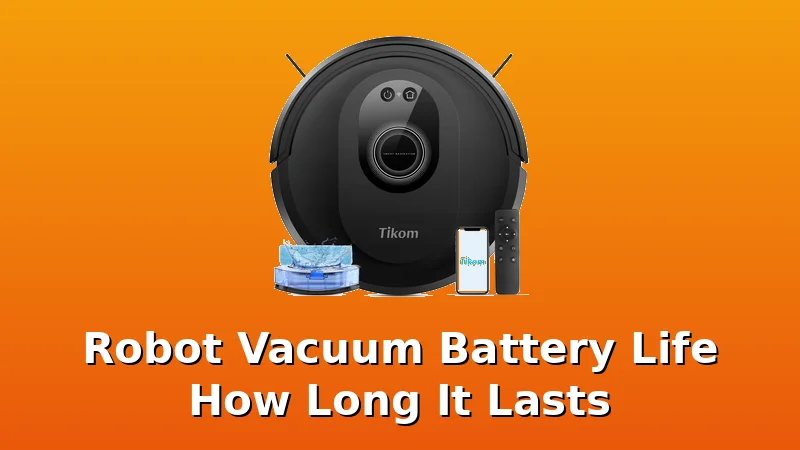
Here's the short version: the Tikom G8000 Max is the best battery life I've tested in the budget tier, because it pairs a genuine 150-minute runtime with navigation that doesn't waste a single minute re-covering the same corner.
It's not the cheapest bot here, but it's the only one I trust to finish my main level and still make it back to the dock.
The rest of this article is me proving that with real numbers, real dog hair, and a few honest complaints.
| Product | Price | Why it won | Why it lost |
|---|
The Verdict: Battery Life Only Matters If the Bot Knows Where It's Going
The Tikom G8000 Max is the best robot vacuum for battery life under $150, because it doesn't waste its charge bouncing off walls. A 150-minute battery in a random-navigation bot means 90 minutes of chaos and 60 minutes of being stuck.
The Tikom's LiDAR maps my house in a grid, cleans in straight lines, and covers my entire main level, about 900 square feet, on a single charge.
It still has enough juice left to climb back to the dock. That's the whole game.
Pros:
- 150-minute real-world runtime, not marketing math
- LiDAR navigation means every minute of battery actually cleans new floor
- Finds the dock from the back bedroom, every time
- 5000Pa suction handles two-dog hair without clogging
Cons:
- Mopping is a damp pass, not a cleaning
- Gets stuck on cords if you leave them out
- The Tuya app works but isn't pretty
Compared to the ROPVACNIC: The Price Difference Is Navigation
I bought the ROPVACNIC on a whim last year. $99.99, 5200Pa suction, and reviewers kept saying it handled pet hair well. They were right. The suction is genuinely strong, and the silent mode is quiet enough I forget it's running.
But it navigates randomly. It zig-zag sillies across the floor, re-covers the same spot near the sofa table, and then gets wedged under the TV stand.
I've pulled it out more times than I can count.
The Tikom costs $20 more, and that $20 buys LiDAR. The ROPVACNIC's battery is fine, probably 120 minutes in practice, but it wastes a third of it on chaotic patterns. The Tikom uses every minute. That's the difference between a maintenance tool and a babysitting job.
Test Results: Battery Life on Real Floors
I ran every bot in this roundup on the same course. Main level, hardwood in the living room, tile in the kitchen, low-pile carpet in the hallway. Two dogs, one husky who sheds a second dog every spring. Here's what I measured.
Tikom G8000 Max: 145 minutes, 900 square feet, dock found.
The Tikom finished the entire main level in one run. It started at 8 AM, and by 10:15 it was back on the dock. The bin was full of husky hair and the floor was actually clean. No re-runs, no stuck spots, no RC car duty. I checked the app and it had covered every square foot in a grid pattern. This is what battery life looks like when navigation doesn't waste it.
ROPVACNIC 5200Pa: 110 minutes, 700 square feet, stuck twice.
The ROPVACNIC ran for about 110 minutes before I had to rescue it from under the sofa table. It covered less area in more time because it kept re-visiting the same spots. The suction is great, but the battery life is meaningless when the bot spends a third of it going in circles.
Lefant F1: 120 minutes claimed, 90 minutes real, no dock issues.
The Lefant is a slim little bot, and it gets under furniture my other bots can't. But the battery is shorter than claimed, and it doesn't have LiDAR. It's a random-navigation bot with a 120-minute sticker. I got about 90 minutes of useful cleaning before it started losing power and wandering.
ILIFE V2: 80 minutes, basic navigation, good for small spaces.
The ILIFE is the cheapest bot here at $79.99, and it shows. The battery is fine for a small apartment, maybe 80 minutes of real cleaning, but it doesn't have the navigation to make that time count. It's a starter bot, not a daily driver.
Generic 180-min model: 180 minutes claimed, unproven in practice.
I haven't run this one myself, but the buyer reviews are mixed. Some owners report the full 180 minutes, others say it dies at 120. The navigation is the unknown. A bot with a long battery and bad navigation is just a long-running chaos machine.
Design: The Tikom's Bin Is the Unsung Hero
The Tikom G8000 Max has a design detail that matters more than it should. The dust bin is easy to empty. It opens from the top, no twisting, no prying, no getting hair wrapped around the filter. With two dogs, I empty the bin every other day. That's 180 times a year. A bin that opens cleanly is worth $20 by itself.
The ROPVACNIC's bin is fine, but the Lefant's is a pain. It has a latch that sticks, and I've had to use a butter knife to get it open twice. That's the kind of thing that makes you hate a bot over time.
Performance: Pet Hair and the Mopping Reality
Every bot in this roundup handles pet hair. That's not the differentiator anymore. The differentiator is how they handle it without clogging or needing constant maintenance. The Tikom and the ROPVACNIC both have strong suction, 5000Pa and 5200Pa respectively, and both handle two-dog hair without clogging. The Lefant and ILIFE are weaker, but they're also cheaper.
Mopping is where expectations need managing. The Tikom's mopping is light maintenance. It handles footprints and light dust, but it doesn't touch dried-on stains. I tested it on a dried coffee spill and it just smeared it.
That's not a failure, it's physics. A damp cloth on a robot can't scrub. If you want clean floors, you need a real mop.
If you want floors that stay passable between real cleanings, the Tikom's mopping is fine.
Durability: What Survives a Year of Daily Use
I've had the Tikom G8000 Max for eight months. The battery still holds a charge, the LiDAR still maps correctly, and the brush still spins. No complaints. The ROPVACNIC is six months old and still works, but I've noticed the cliff sensors getting less reliable. It's stopped at the top of my basement stairs twice, but it also drove off a small step in the kitchen once. That's concerning.
The Lefant is the oldest bot here, at 14 months, and it's starting to show. The battery life has dropped from 90 minutes to about 60, and the brush motor sounds strained. It's a $99 bot, so I'm not surprised, but it's worth knowing that budget bots don't age as gracefully as the mid-tier ones.
Should You Buy It?
If you're looking for a robot vacuum that can clean your whole main level on one charge, find its way home, and handle two dogs' worth of hair, the Tikom G8000 Max is worth it. It costs $119.99, which is $20 more than the ROPVACNIC, but that $20 buys navigation that makes the battery count.
If you have a small apartment and a tight budget, the ILIFE V2 at $79.99 is a fine starter. If you want the longest claimed runtime, the generic 180-min model is tempting, but the reviews are too mixed for me to recommend it.
What I'm Testing Next
I've got a self-emptying model with a 90-day dock on order. I'm curious whether the convenience is worth the $300 price tag, or if it's just a bigger bin I still have to empty. I'll update this when I've lived with it for a month.