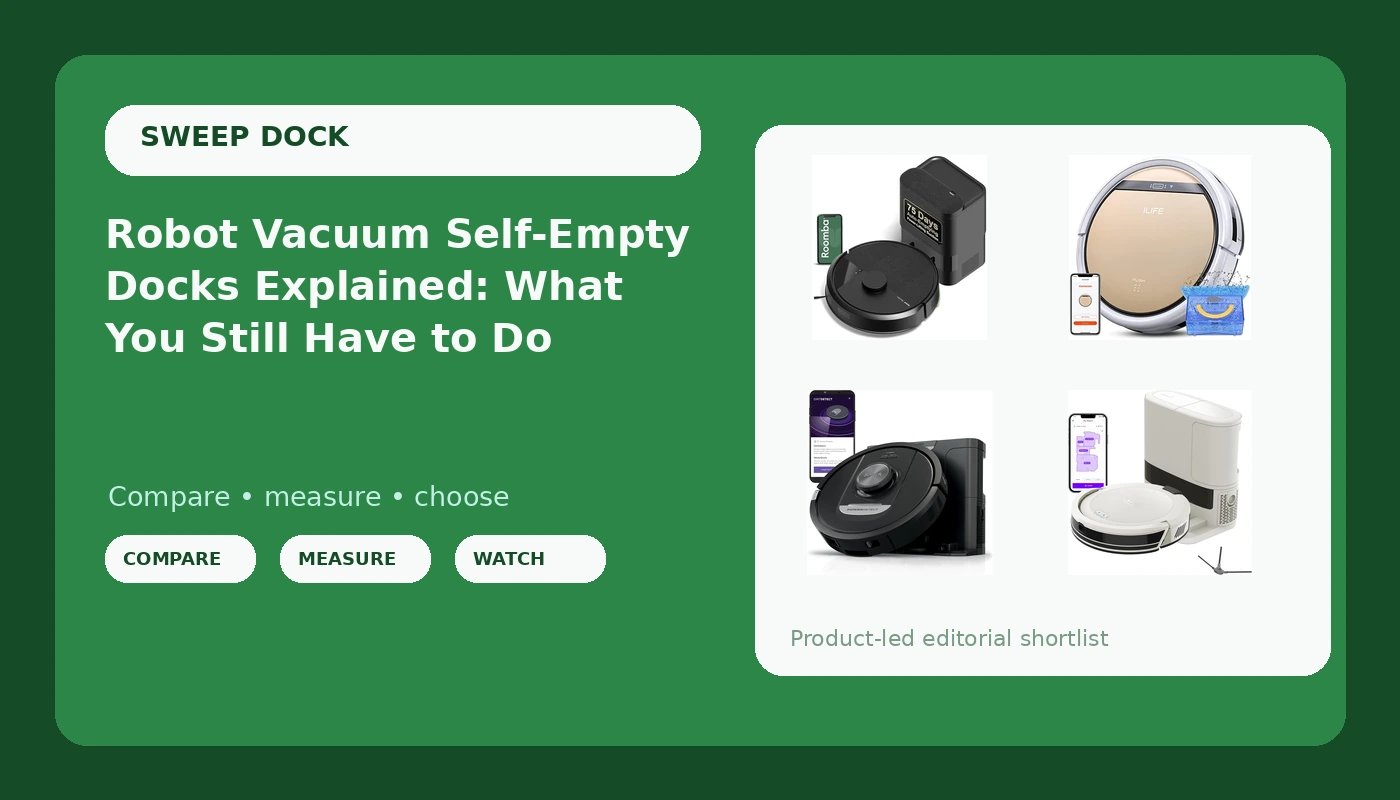
A self-emptying robot vacuum solves one very specific problem: the bin. Everything else about the machine, the navigation, the pickup, the way it handles pet hair, stays exactly as good or as mediocre as it already was. What changes is that you stop pulling a dust bin out of the robot every day or two and start swapping a bag in the dock every month or two. That is the honest version of the pitch, and it is worth real money if you have ever gagged while emptying a bin packed with dog hair.
The trouble is that "self-emptying" has become a marketing umbrella. It covers docks that hold a few weeks of debris and docks that hold much more, robots with laser mapping and robots that still bounce off walls, and bundles where the only new part is the base. So the useful question is not whether a robot self-empties. It is what the dock holds, what the robot does between dock visits, and how much babysitting the rest of the machine still demands.
Related: LiDAR vs Random Navigation in Robot Vacuums →
Quick answer
A self-emptying robot vacuum pulls debris out of the robot's own bin and into a sealed bag or container inside the charging dock, so you empty the dock instead of the robot. The dock does not clean the brush roll, the filter, or the sensors, and it cannot rescue weak navigation. Buy one for fewer bin trips, then judge it on mapping, floor transitions, and pet hair pickup first.
Four useful options
| Model | Best fit | What stands out |
|---|---|---|
| Shark PowerDetect Self-Empty Robot Vacuum, Black, AV2820S | Buyers who want Shark's newest self-empty platform | Self-empty base paired with the PowerDetect line |
| iRobot Roomba 105 Vac Robot Vacuum with AutoEmpty Dock | Hands-off scheduling in a mapped home | Self-empty dock described as 75 days between bag changes, plus LiDAR navigation and row-by-row cleaning |
| Shark Navigator Robot Vacuum + Self-Empty Base, White, AV2110S | A simpler self-empty setup | Robot and self-empty base sold together in white |
| ILIFE V5s Plus Robot Vacuum and Mop Combo | Hard floors that need a light daily mop pass | Vacuum and mop combination in a single unit |
The flagship self-empty pick: Shark PowerDetect Self-Empty Robot Vacuum, Black, AV2820S
Shark's PowerDetect naming is the company's signal that this is the model where its newer navigation and dirt-detection work lives, so the trade-off is straightforward: you are paying for the current generation rather than the value tier. What that means for your floors depends on layout. A rambling ranch house with rooms off a long hallway rewards good mapping and reliable dock-finding, while a two-bedroom apartment gets most of the same benefit from a cheaper mapped robot. Before ordering, check the listing for the dock's bag capacity and the robot's rated runtime, because those two numbers decide how often you actually touch the thing.
The set-and-forget pick: iRobot Roomba 105 Vac Robot Vacuum with AutoEmpty Dock
The 75-day figure is iRobot's claim, and it assumes a home that does not generate two dogs' worth of hair every week, so treat it as the ceiling rather than the schedule. LiDAR navigation is the more consequential line in that name, because a robot that maps your rooms and cleans in rows is the difference between scheduling a run while you are at work and driving the thing around by hand. Roomba's reputation is built on exactly this: the app is not exciting, the cleaning is not dramatic, and it mostly does what it says. The catch is that you pay a brand premium for that consistency, and replacement bags and filters are ongoing costs no dock removes.
The simple self-empty pick: Shark Navigator Robot Vacuum + Self-Empty Base, White, AV2110S
This is the model that makes the case that self-emptying is a feature and not a whole product tier. If your goal is fewer bin trips and you do not care about the newest detection hardware, a Navigator plus base gets you the dock without the flagship markup. What it will not do is outperform the mapping on the models above, so if your house has a room the robot always seems to miss, spend the difference on navigation rather than on dock capacity. Confirm on the listing which navigation system this specific configuration uses, since Shark's naming does not spell it out.
The vacuum and mop combo: ILIFE V5s Plus Robot Vacuum and Mop Combo
This is the one on the list that is not competing on dock convenience at all, and that is fine as long as you know what the mop is for. Robot mopping is light maintenance: it lifts everyday dust, footprints, and the film that builds up on a kitchen floor between real cleanings. It does not lift dried-on stains or sticky spills, and no mop pad on a robot will. If your floors are mostly hard surface and you want a daily wipe without dragging out a bucket, a combo like this earns its place. If your house is carpet and shedding dogs, put the money toward navigation and a self-empty dock instead.
Prices and availability may change. Product images, names, and retailer links must be matched by verified ASIN. Do not state a current price, rating, stock status, or measured result without current evidence.
What a self-emptying dock actually does
The dock is a small vacuum of its own. When the robot returns and parks, the base pulls the contents of the robot's bin into a sealed bag or container, then starts charging. That is the entire mechanism, and it works well. What it does not do is anything else on the maintenance list. The brush roll still collects hair and needs to be cut free. The filter still loads up and still needs rinsing or replacing. The sensors and charging contacts still need wiping, because a dirty contact is one of the more common reasons a robot stops finding its way home.
Two practical details decide whether the feature is worth it for you. The first is dock footprint: these bases are considerably larger than a plain charging puck, and they need clear floor space plus a nearby outlet, which in a small house often means the only spot is behind a door. The second is consumables. Bags, filters, and eventually brushes are ongoing purchases, and a longer dock interval usually means a bigger bag, not a bag that lasts forever. A dock advertised as weeks between changes is a claim about the bag and the dust volume your home produces, not a promise that you can forget the robot exists.
How to judge the rest of the robot
Suction is the number printed largest on the box and the least useful one for comparing these machines. The order that actually matters is navigation, then pickup on your specific floor, then the dock.
- Find out whether the robot maps with LiDAR or navigates randomly. Mapping is what allows no-go zones, room-by-room cleaning, and a reliable trip back to the dock from the far bedroom.
- Check how it handles your worst transition. Hardwood to tile to a low-pile carpet edge is where cheap robots stall, spin, and give up.
- Look at the brush roll design if you have pets. Hair wrapping around a roller is the single most common reason a robot's pickup quietly drops off after a few weeks.
- Decide what mopping means to you. If you want a daily wipe of hard floors, a combo works. If you want stains gone, that is a mop and a bucket, not a robot.
- Confirm runtime and dock-finding behavior together. A robot with a long runtime that cannot find its dock from the back of the house is a robot you will be carrying.
What to check before you order
- Where the dock will physically live, including clearance for the robot to approach it and an outlet within reach.
- Whether the robot's navigation is mapped or random, because this drives everything about how much you babysit it.
- The brush roll type and whether hair tangles around it, especially with a shedding dog in the house.
- The ongoing cost of bags, filters, and brushes, which no self-empty dock eliminates.
- Whether the robot can handle your floor mix on a single charge, or whether you will need to run it room by room.
Which option should you choose?
Choose the Shark PowerDetect Self-Empty Robot Vacuum, Black, AV2820S when you want Shark's current self-empty platform and the newest navigation work in its range. Choose the iRobot Roomba 105 Vac Robot Vacuum with AutoEmpty Dock when the longest dock interval on this list and mapped, row-by-row cleaning matter more to you than saving money up front. Choose the Shark Navigator Robot Vacuum + Self-Empty Base, White, AV2110S when the dock is the feature you actually want and you would rather not pay for the flagship tier. Choose the ILIFE V5s Plus Robot Vacuum and Mop Combo when your floors are mostly hard surface and a light daily mop pass is the job you need done.
The caveat is the same for all four. The 75-day dock figure, runtime, and suction ratings are manufacturer claims, and the only ones you should treat as settled are the features named in each product listing. Nothing here replaces a full-size vacuum for carpet deep cleaning, and none of these docks means you never touch the robot again.
The bottom line
A self-emptying robot vacuum is a convenience purchase, and it is a good one if you have ever emptied a bin of pet hair by hand. It buys you fewer bin trips and nothing else, so pick the robot on navigation and floor handling first, then let the dock decide between models. If your home is mapped, mostly hard floor, and shedding constantly, the self-empty models here earn their keep. If it is not, the combo unit and a bit more hands-on time will do the same job for less.