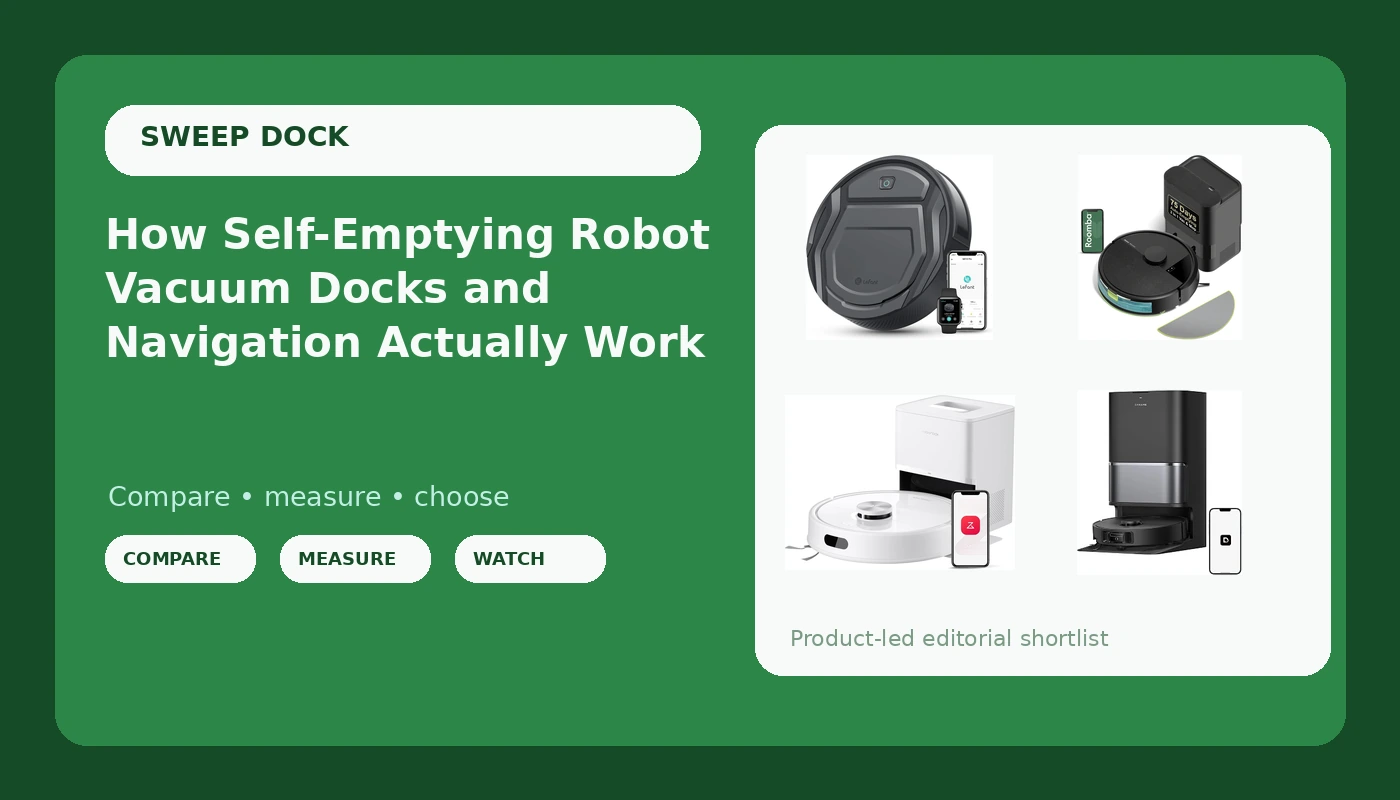
A self-emptying robot vacuum sounds like the point where you stop thinking about floor care. In practice, the dock is one feature among several, and it is rarely the one that decides whether you like the machine. Navigation decides that. A robot that maps your rooms, respects your no-go zones, and finds its dock from the back bedroom is one you can schedule and forget. A robot that bumps around in a random pattern is one you end up following through the house. This explainer covers what each step up in a robot vacuum lineup actually buys, using four current models as reference points, from a thin budget unit to a high-suction flagship.
Related: LiDAR vs Random Navigation: What Actually Changes in a Real House →
Quick answer
A self-emptying robot vacuum is a convenience upgrade, not a hands-off one. The dock moves debris from the robot's bin into a larger bag so you empty it weekly or monthly instead of daily, but you still clean filters and brushes. Buy for navigation first: LiDAR mapping, reliable dock return, and app-based no-go zones change how much supervision a robot needs. Suction matters most on carpet and for embedded pet hair, and robot mopping is light maintenance rather than deep cleaning.
Four useful options
| Model | Best fit | What stands out |
|---|---|---|
| Lefant M210P | Hard floors and tight budgets | 4,000Pa suction, claimed 200-minute runtime, app and voice control |
| iRobot Roomba 105 Combo | Buyers who want a familiar brand and a self-empty dock | LiDAR navigation, AutoEmpty dock described as up to 75 days, carpet-aware mopping |
| roborock Q7 M5+ | Mid-tier buyers who want self-empty plus more suction | 10,000Pa suction and a dock described as up to 7 to 9 weeks |
| dreame L40 Ultra Gen 2 | Carpet and heavy pet hair | 25,000Pa listed suction in a vacuum and mop combination |
The budget baseline: Lefant M210P
What you give up at this level is mapping. Nothing in the M210P listing promises LiDAR or a stored floor plan, so expect the robot to work through a space rather than navigate a map of it. That is fine in a small, uncluttered apartment and less fine in a house with cords behind the sofa and a rug that curls at the edge. If you want a robot that cleans one room while you are home, this is a reasonable place to start. If you want one that runs while you are at work, navigation is the feature you are actually shopping for.
The familiar name: iRobot Roomba 105 Combo
This is the model for someone who wants a recognizable name and does not want to think about the robot much. LiDAR navigation plus a self-empty dock covers the two features that reduce daily interaction, and the carpet-avoidance behavior matters if your bedrooms are low-pile carpet and your kitchen is tile. The trade-off is that you are paying for brand familiarity and app polish as much as for hardware, and the suction figure is described in marketing language rather than a number you can compare directly against the 10,000Pa and 25,000Pa listings here.
The mid-tier self-empty value: roborock Q7 M5+
If you want a self-emptying dock without paying flagship money, this is roughly the shape of that purchase. The dock cuts down how often you handle debris, and 10,000Pa is a meaningful step above the entry-level suction figure. What the listing does not spell out is the navigation hardware, so check the current product page before you assume mapping features. Treat the self-empty interval as an estimate for normal use, because a home with two heavy shedders fills a bag faster than a single-cat apartment.
The high-suction option: dreame L40 Ultra Gen 2
Suction at this level is about carpet and hair that has worked into the pile, not about hard floors, where almost any robot in this group handles the visible debris. Higher suction also tends to arrive with a higher price and, often, a louder run. The listing here does not describe a self-empty dock, so if dock capacity is what you care about, compare it against the roborock and Roomba entries instead of assuming one is included.
Prices and availability may change. Product images, names, and retailer links are matched to verified listings. No current price, rating, stock status, or measured result is stated here without current evidence.
Why navigation matters more than the suction number
Suction is the easiest spec to print on a box and the hardest to compare across brands. There is no shared standard for how these figures are measured, so a 4,000Pa listing and a 25,000Pa listing are not tested on the same bench with the same nozzle and the same carpet. That does not make the numbers useless. It means they describe relative ambition rather than a guaranteed result.
Navigation is different, because you can watch it work. LiDAR uses a laser to build a map of the room, which is what lets a robot clean in rows, remember where it has been, and return to its dock without wandering. Random navigation has no map, so the robot covers ground by bumping and turning until it has been everywhere it can reach. Both approaches eventually touch most of a floor. Only one does it in a predictable amount of time.
The practical difference shows up in three places: how long a run takes, whether the robot returns to the dock on its own, and whether you can fence off problem areas like the cable nest behind the TV stand. Those three things decide how much you supervise the machine.
What a self-emptying dock does and does not do
A self-emptying dock pulls the contents of the robot's bin into a bag or container in the base. You stop emptying a small bin after every run and instead deal with a larger bag every few weeks, depending on how much floor the robot covers and how much debris your household generates.
It does not remove maintenance. Filters still need cleaning or replacing, brushes still collect hair, the dock itself gathers dust, and the bag eventually fills. A dock described as lasting 75 days or 7 to 9 weeks is an estimate under normal conditions, not a promise for a home with two shedding dogs.
It also does not fix navigation. A self-emptying robot that cannot find its dock is still a robot you carry back to the dock, which defeats the point.
- Measure the floors the robot will actually clean, room by room, rather than the whole house.
- Identify your floor mix, since hardwood and tile are easy, low-pile carpet is moderate, and high-pile carpet is where suction and brush design matter most.
- Decide whether you need mapping, which mostly comes down to whether the robot will run while you are out.
- Count the cords, rug edges, and low-clearance furniture in the main rooms, because those are what generate stuck events.
- Pick the dock capacity you can live with, then confirm the current listing still describes it the same way.
Matching a robot to your floors and your patience
- Hardwood and tile: almost any robot here handles visible debris, so spend the budget on navigation and dock capacity instead of suction.
- Low-pile carpet: suction and a powered brush matter more, which is where the 10,000Pa and 25,000Pa listings are aimed.
- Pet hair: expect to cut hair off the brush roll on any model, and treat the self-empty interval as shorter than advertised in a multi-pet home.
- Mopping: a robot mop handles footprints and light dust, not dried-on spills, so keep a manual mop for the kitchen.
- Supervision: if the robot runs while you are away, mapping and no-go zones are the features that keep a stuck robot from dying in a hallway.
Which option should you choose?
Choose the Lefant M210P Robot Vacuum Cleaner, 4000pa Suction, 200 Mins Runtime, Super Thin, Quiet, Self-Charging, Ideal for Pet Owners, Multi Surface Cleaning, APP/WiFi/Alexa Control, Gray when you want a thin, low-cost vacuum for hard floors and you will be home while it runs. Choose the iRobot Roomba 105 Combo Robot Vacuum & Mop with AutoEmpty Dock - Self-Empties for 75 Days, Intense Power-Lifting Suction, LiDAR Navigation, Multiple Cleaning Modes, Avoids Mopping Carpet when a self-empty dock and LiDAR navigation matter more than the suction figure. Choose the roborock Q7 M5+ Robot Vacuum and Mop, Up to 7-9 Weeks Self-Empty, 10000Pa when you want a self-empty dock and 10,000Pa suction without flagship pricing. Choose the dreame L40 Ultra Gen 2 Robot Vacuum and Mop with 25,000Pa Suction when high suction for carpet and pet hair is the priority.
Every spec here comes from the product listings rather than a measured test in your home, and dock intervals, runtime, and suction figures are all conditions-dependent. Check the current listing for the model you are considering, because features and dock designs change between revisions that share a name.
The bottom line
A self-emptying robot vacuum solves one chore, and navigation solves the rest. If you can prioritize only one thing, prioritize the ability to map a floor, avoid a no-go zone, and find the dock without help. Then decide how much suction your carpet needs and how much dock capacity your household will fill. The Lefant M210P is the entry point for hard floors, the Roomba 105 Combo and roborock Q7 M5+ are the two self-empty options at different price points, and the dreame L40 Ultra Gen 2 is the one to look at when carpet and pet hair are the real test.