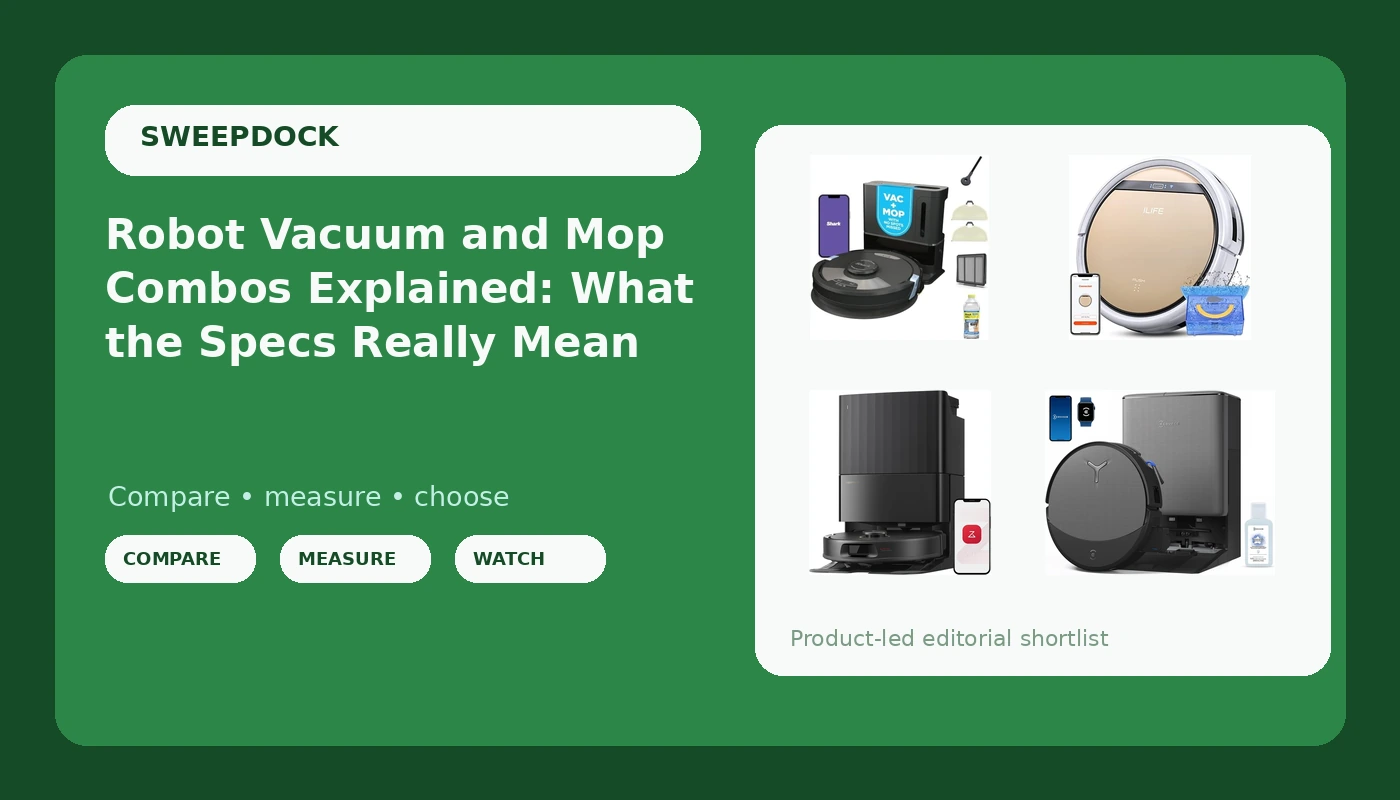
Robot vacuum and mop combos are sold on a promise that is only half true. The vacuum half is real: a decent robot keeps hard floors and low-pile carpet clear of crumbs, dust, and pet hair on a daily basis without you thinking about it. The mop half is where expectations go sideways, because most combo units are doing light maintenance, not deep cleaning. This explainer walks through what the spec sheet is actually telling you, where the marketing overshoots, and how to match a model to the floors in your house rather than to the biggest number printed on the box.
Related: LiDAR vs Random Navigation in Robot Vacuums →
Quick answer
A robot vacuum and mop combo is worth buying if you want daily upkeep on hard floors and low-pile carpet, and you accept that the mop side handles footprints and light dust rather than dried-on spills. The decision comes down to three practical questions: how the robot navigates your layout, how much square footage it covers on a single charge, and how much dock and bin maintenance you are willing to do between runs. Buy for the vacuuming first, treat the mopping as a bonus, and you will rarely be disappointed.
Four useful options
| Model | Best fit | What stands out |
|---|---|---|
| ILIFE V5s Plus Robot Vacuum and Mop Combo | Small apartments and first-time buyers | Vacuum and mop combination in one entry-tier unit |
| SharkMatrix Plus 2-in-1 Robot Vacuum & Mop, Black/Brass, AV2610WA | Mixed hardwood and low-pile carpet in a mid-size home | 2-in-1 vacuum and mop design in the Shark Matrix Plus line |
| roborock Qrevo S5V Robot Vacuum and Mop, FlexiArm Edge Mopping | Homes with hard floors and a lot of edges and corners | FlexiArm edge mopping named in the product listing |
| ECOVACS DEEBOT T90 PRO Omni Robot Vacuum and Mop, 30000Pa Blast Suction | Larger homes and buyers who want a more capable dock | 30,000Pa suction figure and Omni dock designation stated in the name |
The entry point: ILIFE V5s Plus Robot Vacuum and Mop Combo
The trade-off at this tier is not the vacuuming, it is the babysitting. Entry-level combo units tend to be the ones that find a phone cord, a rug transition, or the space under the sofa table and stay there until you intervene. That is not a defect unique to this model, it is the honest cost of buying at the bottom of the category. If your home is one open room and a hallway with few obstacles, this is a reasonable place to start. If you have three bedrooms, two dogs, and a cable nest behind the TV stand, budget for a model that maps.
The mid-range all-rounder: SharkMatrix Plus 2-in-1 Robot Vacuum & Mop, Black/Brass, AV2610WA
Mid-range is where the category stops being a novelty. You are paying for better hardware and better software than the entry tier, and the practical difference shows up in how often you have to rescue the robot rather than in how shiny the floor looks. The honest caveat: a 2-in-1 design means the same unit carries both jobs, so you are not getting a dedicated mop with scrubbing pressure. Expect it to lift everyday dust and footprints, and keep a real mop for the sticky spill that dried while you were at work.
The edge-mopping option: roborock Qrevo S5V Robot Vacuum and Mop, FlexiArm Edge Mopping
Edge cleaning is the detail people notice most after a few months of ownership, because a robot that leaves a two-inch band of dust around every wall looks worse than no robot at all. An arm that reaches out to the edge is the fix, and it is the kind of feature that separates a premium unit from a mid-range one. The trade-off is cost and complexity: more moving parts on the underside means more to keep clean, and premium pricing is premium pricing. If your main floor is mostly hard surface with visible baseboards, this is the category where the money goes furthest.
The high-capacity dock option: ECOVACS DEEBOT T90 PRO Omni Robot Vacuum and Mop, 30000Pa Blast Suction
A dock with more capability is the single biggest quality-of-life upgrade in this category, and it is also the most oversold. Self-emptying means you are not emptying a bin every other day; it does not mean you never touch the machine. Filters still need rinsing, bags still need replacing, and the dock itself still collects dust. The realistic framing is that a capable dock turns a daily chore into a monthly one, which is a genuine improvement, just not the hands-off fantasy the packaging suggests.
Prices and availability may change. Product images, names, and retailer links must be matched by verified ASIN. Do not state a current price, rating, stock status, or measured result without current evidence.
What suction ratings actually measure
The pascal figure on a robot vacuum box is a pressure measurement, and pressure is only one ingredient in pickup. A machine with a huge number and a weak seal around the brushroll will leave a trail of husky hair across a rug. A machine with a smaller number, a well-sealed housing, and a brushroll that agitates carpet will pull more out of the fibers on a single pass.
That is why the number is a starting point, not a verdict. What actually determines whether your floor gets clean is the combination of airflow, brush design, how many passes the robot makes over the same spot, and whether it can reach the areas where debris accumulates. Corners, baseboard edges, and the strip under the kitchen cabinets are where cheap navigation shows up as visible dirt.
For pet hair specifically, the test that matters is tangling. Hair wraps around a brushroll and slowly strangles it, which drops pickup on every subsequent run. Any robot you buy for a shedding household needs to be judged on what its brush looks like after a week, not on the suction figure in the listing.
Navigation, docks, and mopping limits worth verifying
Navigation is the spec that decides whether you like the robot in month three. Random-navigation units bounce and re-cover the same corner while skipping the hallway. Mapping units build a floor plan, let you set no-go zones around dog bowls and cable nests, and return to the dock when the battery runs low instead of dying under the bed.
Dock features sit on a spectrum. A basic dock charges. A more capable dock also handles bin contents, and possibly mop pad washing or drying, which is where the maintenance burden drops from days to weeks. Check what the dock actually does rather than what the word on the box implies, and check what still needs your hands: filters, bags, pads, and the water tank.
Mopping deserves its own reality check. A robot mop drags a damp pad or spins a small disc across the floor. It picks up dust, footprints, and light kitchen traffic. It does not scrub a dried-on sauce stain off tile, and it does not replace a real mop for a deep clean. Set that expectation before you buy and the mopping feature will feel like a genuine convenience instead of a disappointment.
- Measure the floor area you want covered on one charge, and be honest about whether the robot can finish it before the battery drops.
- Walk your rooms and count the obstacles: cords, rug edges, pet bowls, chair legs, and low furniture the robot could wedge under.
- Decide whether you need a floor map and no-go zones, or whether a simpler unit is enough for one open room.
- Check what the dock does and what still needs manual maintenance, including filters, bags, and mop pads.
- Set a realistic expectation for mopping: light upkeep on hard floors, not stain removal.
Practical guidance for living with a combo unit
- Run the robot daily rather than weekly. Small, frequent passes handle pet hair far better than one long session on a heavily soiled floor.
- Clear cords and small objects before the first run, then note where it gets stuck and fix those spots permanently.
- Keep low-pile carpet in mind for the vacuum side and hard flooring for the mop side. The same unit performs differently on each.
- Empty the bin, rinse the filter, and check the brushroll for wrapped hair on a schedule, because a clogged robot cleans nothing.
- Do not schedule runs and leave the house until you trust the machine to find its dock from the farthest room.
Which option should you choose?
Choose the ILIFE V5s Plus Robot Vacuum and Mop Combo when you have a small, simple floor plan and want to try a combo unit without spending flagship money. Choose the SharkMatrix Plus 2-in-1 Robot Vacuum & Mop, Black/Brass, AV2610WA when you want a mid-range 2-in-1 for a mix of hardwood and low-pile carpet. Choose the roborock Qrevo S5V Robot Vacuum and Mop, FlexiArm Edge Mopping when baseboards and corners bother you more than anything else on the floor. Choose the ECOVACS DEEBOT T90 PRO Omni Robot Vacuum and Mop, 30000Pa Blast Suction when you want the most capable dock in the group and are prepared for the maintenance that a dock does not eliminate.
One caveat applies to all four. Suction figures, dock descriptions, and mopping claims in product names are manufacturer statements, not measured results, and none of them tell you how the robot will behave in your specific house. The features described here are drawn from the product listings; the behavior on your floors depends on your layout, your furniture, and how much shedding your household produces.
The bottom line
A robot vacuum and mop combo is a maintenance tool that keeps hard floors and low-pile carpet presentable between real cleanings. Buy the vacuuming capability first, treat the mopping as light upkeep, and judge the dock by how much maintenance it genuinely removes rather than by how hands-off the marketing sounds. If your budget stops at the entry tier, accept that you will occasionally pull the robot out from under the furniture. If you can stretch to a mapping unit with a more capable dock, you are paying for fewer rescues and less time spent thinking about your floors, which is the entire point of owning one.