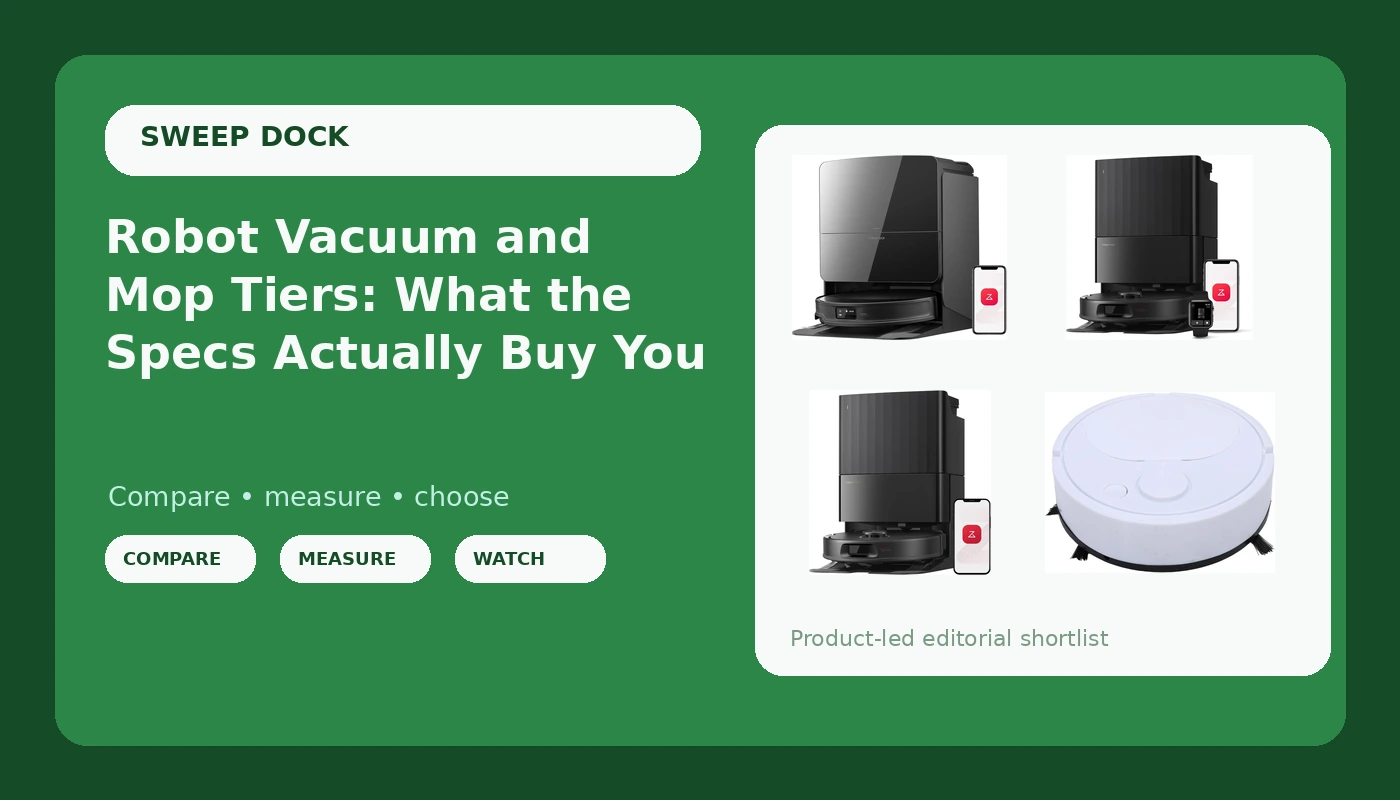
Shopping for a robot vacuum and mop has gotten strange. Four units can sit on the same shelf page, described with the same half-dozen words, and still be built for completely different jobs. One is a 22000Pa flagship with edge cleaning, one leans on a FlexiArm for the edges of a room, one is a mid-tier Qrevo in a newer revision, and one is a mini cleaner small enough to live on a desk. The names do not tell you which one belongs in your house, and the spec sheet only tells you half the story.
Here is the part most listings skip: a robot vacuum and mop is a maintenance tool, not a replacement for the vacuum in your closet. It keeps everyday grit off the floor between real cleanings. Once you accept that, choosing between these four gets much simpler, because you stop shopping for the biggest number on the box and start shopping for the floor you actually have.
This guide covers the four models in this group, what each one is built for, and the questions that decide it. No invented test results, no ratings, no dynamic prices, just what the listings say and how to read them.
Related: How robot vacuum navigation actually works →
Quick answer
Match the robot to the floor and the mess, not to the biggest number on the box. The roborock Saros 10R is the pick when you want the highest listed suction in this group plus edge cleaning. The roborock Qrevo S5V is the pick when edges and baseboards are the problem you keep noticing. The roborock Qrevo Series model is the pick when you want the Qrevo platform in its newer revision. The Asixxsix Mini is the pick for small, awkward spaces a full-size robot cannot reach. Check current Amazon price on any of them before you commit, since these listings move.
4 useful options
| Model | Best fit | What stands out |
|---|---|---|
| roborock Saros 10R Robot Vacuum and Mop, 22000Pa, Edge Cleaning | Larger homes with mixed hard floor and carpet | Highest listed suction in this group at 22000Pa, plus edge cleaning |
| roborock Qrevo S5V Robot Vacuum and Mop, FlexiArm Edge Mopping | Homes where baseboards and room edges get dirty fast | FlexiArm edge mopping for the strip along walls |
| roborock Qrevo Series Robot Vacuum and Mop, Upgraded from Qrevo S | Buyers who want the Qrevo family in its newer revision | Positioned as an upgrade over the Qrevo S |
| Asixxsix Mini Robot Vacuum Cleaner with 300mAh Battery | Desks, tight corners, and small hard-floor areas | 300mAh battery, multi-level filtration, obstacle avoidance, low-noise design per the listing |
Highest suction: roborock Saros 10R Robot Vacuum and Mop
Suction ratings are the easiest spec to market and the hardest to interpret. A 22000Pa figure describes how hard the motor pulls at the inlet, not how much debris ends up in the bin. Real pickup depends on the brush roll, the seal against the floor, and how long the robot lingers in one spot. What the number does tell you is where a model sits inside its own family, and here it sits at the top.
The practical trade-off is the same one that shows up at every tier. More suction generally means more power draw, more noise, and a higher position in the brand's lineup. Edge cleaning matters more than most people expect, because the strip along the wall is where a round robot naturally misses. If your main floor is a mix of hard surface and low-pile carpet, and hair at the rug transitions is the thing you keep noticing, this is the model in this group built for that job.
Edge mopping: roborock Qrevo S5V Robot Vacuum and Mop
Robot mopping is light maintenance, and it is worth being honest about that before you spend anything. It lifts everyday footprints, dust film, and the grit that walks in from the porch. It does not scrub a dried-on sauce stain off tile, and no dock in this class changes that. What edge mopping does change is coverage. A standard round mop pad leaves an untouched border around the perimeter of every room, and on a light-colored floor that border is the first thing you see a week later.
If your kitchen and entry are tile or sealed hardwood and the wall line is where the floor looks dingiest, the FlexiArm is the feature that earns its place. If your floors are mostly carpet, that arm is doing very little for you, and the money is better spent on dry pickup.
Newer revision: roborock Qrevo Series Robot Vacuum and Mop
Revision names are where buyers get tripped up, so treat them as information rather than marketing noise. "Upgraded from the Qrevo S" tells you this unit is the successor in a line you may already have researched, and that reviews written about the older model are not a reliable description of this one. Parts change between revisions. Software changes. Dock behavior changes.
The reason to pick this over the S5V is straightforward: if you want the Qrevo platform and the newer revision of it, this is the one carrying that label. The reason to pick the S5V instead is if edge mopping specifically is the gap you are trying to close. Both are the same family of machine doing the same core job, and the difference comes down to which feature you would actually notice on your floor.
Small spaces: Asixxsix Mini Robot Vacuum Cleaner
The 300mAh battery is the number that sets expectations here. A battery that size is built for short sessions, not a single-charge run across a whole main floor, so judge it on the jobs it can finish rather than the jobs a full-size robot finishes. Think desk surfaces, the floor under a standing desk, a hallway by the door, or the tight gap beside a cabinet where a full-size unit simply will not fit.
The filtration and obstacle avoidance claims are the ones that matter for a small unit, because a mini cleaner running on a hard floor near a desk is going to meet cables and crumbs, not wall-to-wall carpet. Read this as a supplement to a full-size robot, not a substitute for one. It handles the tight spots; the bigger machine handles the rooms.
Prices and availability may change. Product images, names, and retailer links must be matched by verified ASIN. Do not state a current price, rating, stock status, or measured result without current evidence.
What the numbers on the box actually mean
Three specs do most of the work in these listings, and all three get misread.
Suction in Pascals. Pa measures pressure at the inlet, which is not the same as how much dirt lands in the bin. A robot with a great seal, a decent brush roll, and slow passes over a dirty strip can out-clean a higher-Pa unit on the same floor. Compare Pa figures within one brand's lineup, where the testing method is usually consistent, and treat cross-brand comparisons with suspicion.
Battery capacity in mAh. Capacity is not runtime. Runtime depends on how much power the robot draws while cleaning, and a vacuum that pulls harder drains the same battery faster. A 300mAh mini and a full-size unit with a much larger pack are not competing on the same axis, which is why the mini belongs in a different conversation.
Filtration stages. Multi-level filtration describes how many layers of media the exhaust air passes through before it leaves the machine. More stages generally means more fine dust and dander captured, which matters in a house with pets. It says nothing about how well the robot cleans the floor, only about what it does with the air it pushes out.
Two more things worth knowing: noise ratings are usually measured in a lab at a fixed distance, and "self-emptying" describes the dock, not the robot. A dock that transfers debris into a bag still has a filter and a bag to maintain, just less often. Check the specific listing for what is actually included, because dock features vary by model and revision.
How to match a robot to your floors
The floor decides more than the spec sheet does.
Hardwood and sealed tile are the easy case. Almost any robot vacuum and mop in this group handles them, and mopping is a real benefit because footprints and dust film show up immediately. Low-pile carpet is harder: the robot needs enough suction and a brush that agitates the fibers, and mopping is irrelevant there. High-pile or frieze carpet is where most robots struggle and where you should expect to keep using your upright vacuum.
Edge design is the second half of the decision. A round robot leaves an untouched border along every wall. Dry edge cleaning addresses that with the brush; FlexiArm edge mopping addresses it with the mop. If your wall lines are visible and your floors are hard, that feature is worth prioritizing. If your rooms are carpeted to the baseboard, it is not.
Then there are thresholds and cords. Every home has two or three spots that catch a robot, and they are usually the same spots every run. Walk your main floor once and count them before you buy.
- Write down your floor mix by room: hardwood, tile, low-pile carpet, high-pile carpet.
- Identify the failure you actually notice now: edges, pet hair at rug transitions, dust under furniture, or a wet floor after muddy paws.
- Decide whether you need mopping at all, or whether dry pickup is the whole job.
- Pick the tier that matches the job, then read that specific listing for the revision, the dock, and what ships in the box.
- Set the expectation before it arrives: this is maintenance between real cleanings, not a replacement for a full vacuum.
Practical guidance before you buy
- Clear cords, pet toys, and loose rugs before the first run, then note which spots still cause trouble and fix those permanently.
- Put the dock somewhere the robot can reach without crossing a threshold it has to fight, ideally against a wall with clearance on both sides.
- Empty the bin after heavy pet-hair runs rather than waiting. A full bin reduces pickup on everything that follows.
- Rinse and dry the mop pad after wet passes so it is not sitting damp between cleanings.
- Judge a robot over a week of real runs, not a single demonstration pass, and check the listing again before you order in case the revision has changed.
Which option should you choose?
Choose the roborock Saros 10R Robot Vacuum and Mop when you want the highest listed suction in this group and edge cleaning along with it, and your main floor mixes hard surface with low-pile carpet. Choose the roborock Qrevo S5V Robot Vacuum and Mop when edge mopping is the specific gap you are trying to close and your floors are mostly hard. Choose the roborock Qrevo Series Robot Vacuum and Mop when you want the Qrevo platform in its newer revision and dry pickup plus standard mopping covers your rooms. Choose the Asixxsix Mini Robot Vacuum Cleaner when the problem is small, tight spaces a full-size robot cannot reach, and you want a supplement rather than a replacement.
One caveat worth repeating: everything above comes from the product listings, not from a lab in your house. Manufacturer spec sheets are claims, and they are the best available evidence until you run the machine on your own floor. Features, included accessories, and availability change between revisions, so confirm the details on the listing before you order.
The bottom line
These four are not four versions of the same machine. Two are Qrevo models split by edge hardware and revision, one is a flagship with the highest suction rating in the group, and one is a mini cleaner for the spaces the others cannot enter. The right choice comes down to your floor mix, whether edges are the visible problem, and whether you need a supplement or a primary robot. A robot vacuum and mop keeps a floor maintained between real cleanings, and the model that fits your rooms will do that job far better than the model with the biggest number on the box.