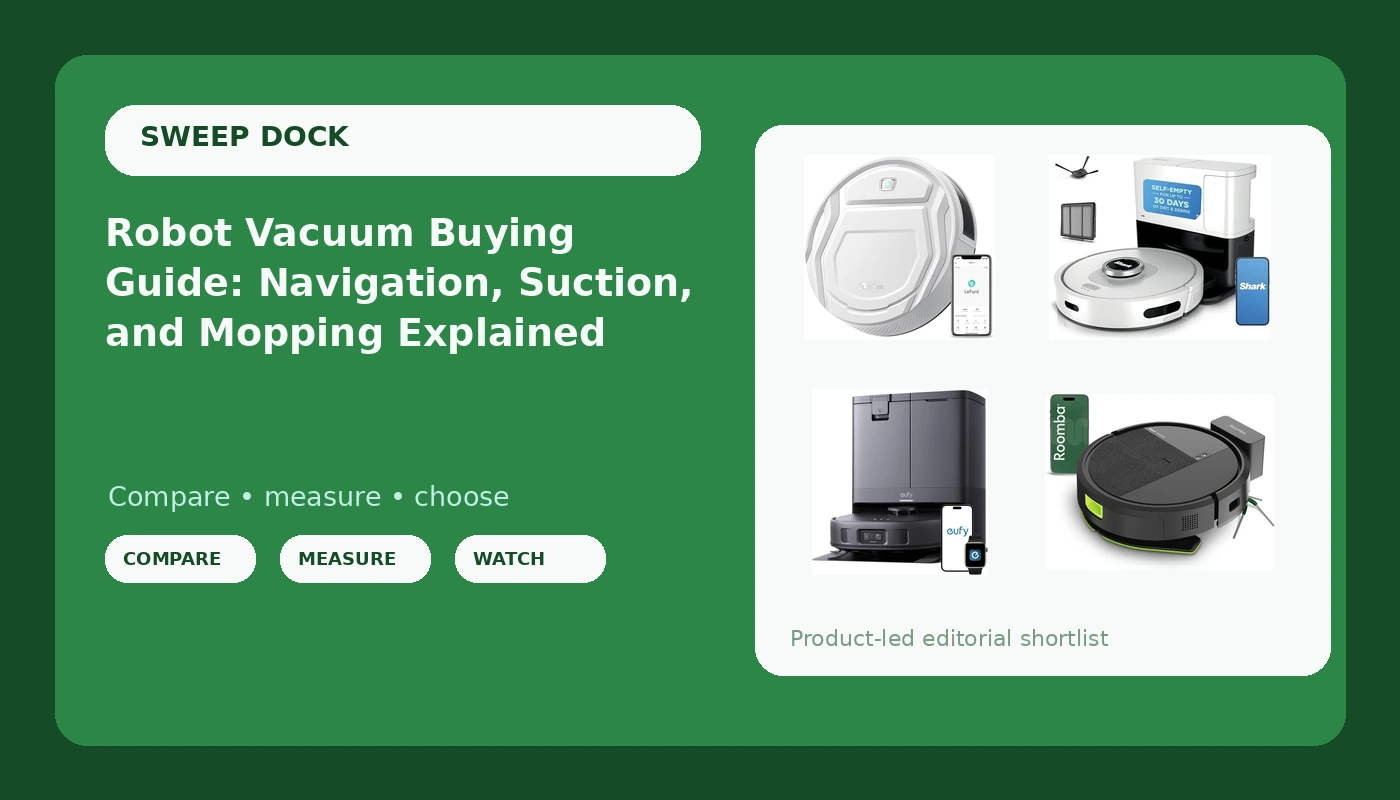
A robot vacuum is a maintenance tool, not a replacement for your real vacuum. That single sentence clears up most of the noise in this robot vacuum buying guide. The numbers printed biggest on the box, suction in pascals and runtime in minutes, are rarely the numbers that decide whether you end up babysitting the thing or forgetting it exists. Navigation decides that. Map quality decides that. Whether it can find its dock from the back bedroom without your help decides that. Below are four current listings, what their published specs actually promise, and where the honest trade-offs sit in a house with hardwood, tile, low-pile carpet, and a couple of shedding dogs.
Related: LiDAR vs Random Navigation in Robot Vacuums →
Quick answer
Pick navigation first, match the mop hardware to the floors you actually have, and treat suction and runtime as tiebreakers rather than headlines. Among these four, the iRobot Roomba 115X Combo is the one that pairs LiDAR navigation with a listed 15,000 Pa suction figure and mop behavior designed to avoid carpets. The eufy X10 Pro Omni is built around mopping, with dual mops that lift 12 mm. The Lefant M210 is the slim, budget-shaped option positioned for pet hair and daily cleaning on hard floors. The Shark AI Ultra is a mainstream AI-navigation vacuum whose record here publishes fewer numbers, which changes how you should shop it. None of them replaces a full-size vacuum for carpet.
Four useful options
| Model | Best fit | What stands out |
|---|---|---|
| iRobot Roomba 115X Combo | Mixed floors that need mapping and carpet-aware mopping | Listed 15,000 Pa suction, LiDAR navigation, multiple cleaning modes, mop that avoids carpets, self-charging |
| Lefant M210 | Budget buyers with hard floors and shedding pets | Listed 120-minute runtime, slim body, low-noise claim, Wi-Fi/App/Alexa control |
| Shark AI Ultra | Shoppers who want a mainstream AI-navigation vacuum | AI Ultra series positioning in black and silver; the record here does not publish suction or runtime figures |
| eufy X10 Pro Omni | Households where mopping is the main event | Vacuum and mop combo with dual mops and 12 mm auto-lift |
Best for LiDAR navigation: iRobot Roomba 115X Combo Robot Vacuum & Mop
The carpet-avoidance behavior is the feature that matters most in a mixed-floor house, more than the suction number. A mop pad that drags across a bedroom rug is a problem you smell before you see. LiDAR is the other half of the value: a robot that maps can work room by room, hold no-go zones, and return to a dock it actually remembers, instead of bouncing off walls in a zig-zag and re-covering the same corner three times. Treat the published suction figure as the listing's claim rather than a measured result, and treat navigation as the thing you can verify by watching one full clean.
Best budget pick: Lefant Robot Vacuum Cleaner, M210
Budget robots deserve to be judged on budget terms. A robot at this end of the market earns its keep by running daily on hardwood and tile, picking up pet hair and dust before it becomes visible, and being light enough to slide under furniture a taller unit cannot reach. What you should not assume from the listing is mapped navigation or app-drawn no-go zones; the record describes suction, runtime, noise, control, and self-charging, not a mapping system. In practice that means picking up cords and clearing the floor before a run rather than fencing the mess off in an app. If the robot has to be unsupervised for hours, this is the category where you will do the most pre-cleaning.
Best mainstream AI option: Shark AI Ultra Robot Vacuum
A thin spec sheet is not a bad sign, but it does change your homework. When a listing does not publish a suction figure or a runtime, do not fill the blanks in yourself, and do not let a familiar brand name do the filling either. Compare the current page on the things you can actually read: whether the navigation is described as mapped or random, how the dock behaves, what replacement brushes and filters cost and how easy they are to find, and whether the app requires an account and a firmware update before it will schedule a single clean. Brand reliability is real, and it is also the thing you pay a premium for. Decide whether that premium is worth it to you before you compare anything else.
Best for mopping: eufy X10 Pro Omni Robot Vacuum and Mop Combo
Auto-lift is the detail to think about, because it decides whether the mop pads stay wet and off your rugs or drag across them. Twelve millimeters of lift is a specific number, and it is the number to hold against the pile height of the rugs you own, not against a marketing claim. The dual-pad design spreads the work over two surfaces instead of one, which matters more for coverage than for scrubbing power. Keep expectations calibrated: robot mopping is light maintenance. It handles footprints, dust film, and everyday traffic marks. It does not remove dried-on stains or sticky spills, and in most homes you will still hand-mop the kitchen after a real cooking session.
Prices and availability may change. Product images, names, and retailer links are matched to verified listings. No current price, rating, stock status, or measured result is stated here without current evidence.
Why navigation matters more than the suction number
Suction only matters if the robot reaches the dirt. A machine with a big suction figure and random navigation will re-cover the same corner three times and skip the hallway entirely, and no amount of airflow fixes a floor it never visited. Mapped navigation, whether by LiDAR or another ranging system, changes the shape of the job: the robot builds a floor plan, cleans in a systematic pattern, lets you fence off the dog bowls and the cable tangle behind the TV stand, and returns to a dock it remembers instead of wandering until the battery dies. The dock-finding run from the farthest room is the honest test, because it is the one that exposes whether the map is real or decorative. If you have ever driven a robot around with your phone like an RC car just to finish a room, you already know which side of this line you want to be on.
What robot mopping actually does
Robot mopping is light maintenance, and the marketing that calls it a deep clean is doing you a disservice. A mop pad that wets and wipes a floor removes the dust film and the footprints from the kitchen to the hallway, and that is genuinely useful when it happens daily. It does not scrub. Dried-on sauce, sticky juice, and anything that has bonded to the tile will still be there, and you will still be on your knees with a real mop for those. The hardware details that matter are the ones that decide how much of the floor the mop is allowed to touch: whether the pads lift and by how much, whether the robot detects carpet and raises or avoids the mop, and how much water it carries. Carpet detection is the one that protects you from the worst outcome, which is a wet mop trail across a bedroom rug.
- Measure the rooms you actually want cleaned daily, and write down the square footage.
- Decide whether you need a map. Room-by-room scheduling and no-go zones require one.
- Match mop hardware to your floor mix, and check lift height against your thickest rug.
- Compare runtime against your real square footage rather than the claimed maximum.
- Read the live listing for the specs that matter, since published figures vary by model and revision.
Practical guidance before you buy
- Pick up phone cords, charging cables, and pet toys before the first run, and watch where the robot struggles.
- Set no-go zones around dog bowls, cable tangles, and the rug it tries to eat, if the model supports zones.
- Run the first few cleans while you are home, so you learn its failure points instead of discovering them later.
- Empty the bin after most runs in a shedding household; a full bin reduces pickup long before it stops the motor.
- Keep a full-size vacuum for carpet, stairs, and edges, and judge the robot only on daily maintenance.
Which option should you choose?
Choose the iRobot Roomba 115X Combo Robot Vacuum & Mop when you have a mix of hard floor and carpet, you want LiDAR navigation doing the work, and you want mop behavior that keeps off the rugs. Choose the Lefant Robot Vacuum Cleaner, M210 when the budget is the constraint, your floors are mostly hard surface, and you are willing to clear the floor before each run. Choose the Shark AI Ultra Robot Vacuum when you want a mainstream AI-navigation machine from an established brand and you are prepared to compare the live listing carefully, since this record publishes fewer numbers. Choose the eufy X10 Pro Omni Robot Vacuum and Mop Combo when mopping is the priority and you want dual mops with a 12 mm lift to clear rugs.
The caveat is the same for all four: the figures quoted above are the listings' published claims, not measured results, and navigation quality is the one thing a spec sheet cannot tell you. Watch a full clean, including the trip back to the dock, before you decide the map is real.
The bottom line
Buy navigation first, mop hardware second, and suction third. A mapped robot that finds its dock and respects your no-go zones will earn its floor space in a shedding household; a high-suction machine that cannot finish a room will end up in a closet. The iRobot Roomba 115X Combo covers the mixed-floor case with LiDAR and carpet-aware mopping, the eufy X10 Pro Omni puts the mopping hardware front and center, the Lefant M210 is the honest budget entry for hard floors and daily pet hair, and the Shark AI Ultra is the mainstream AI option whose details you should confirm on the current listing. Whichever you pick, keep the real vacuum within reach.