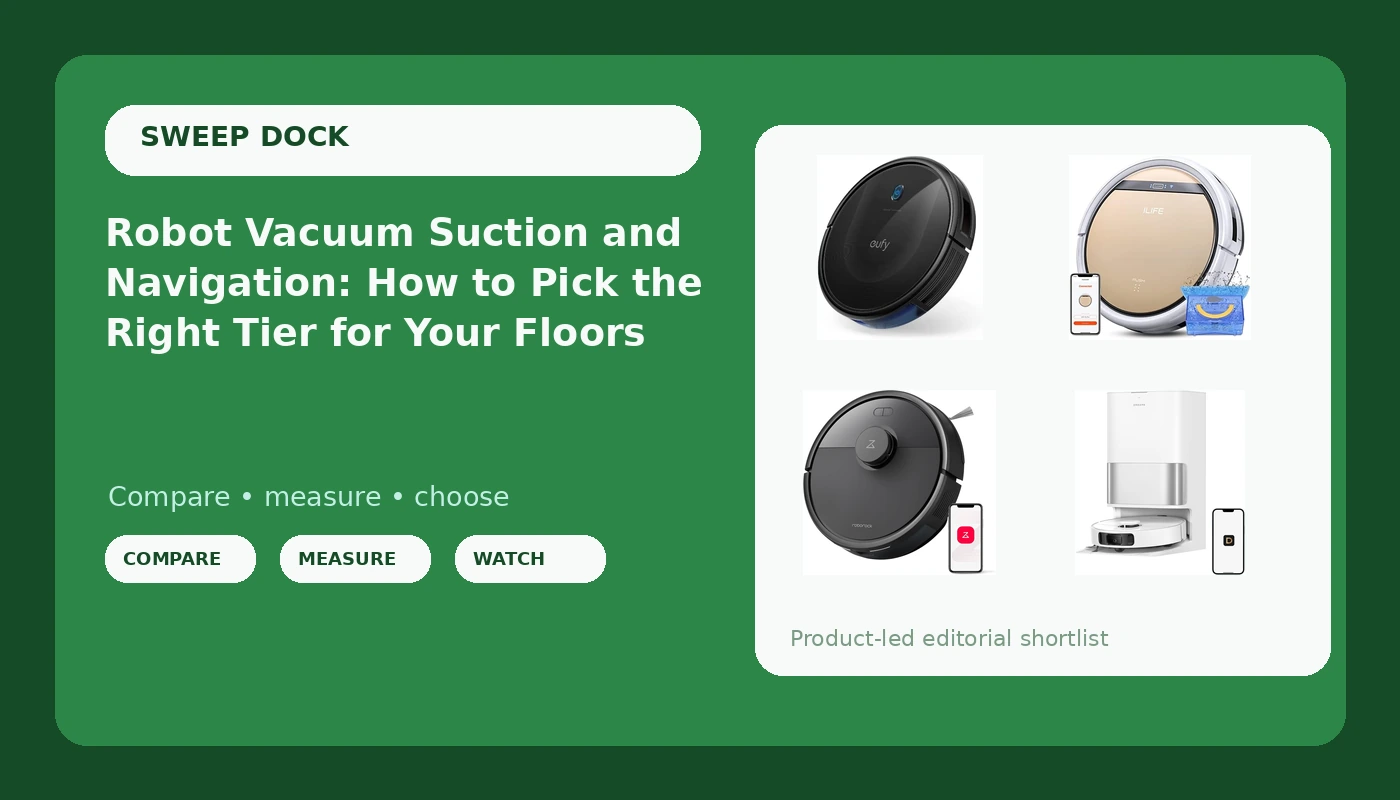
Robot vacuum suction and navigation are the two things that decide whether a machine actually finishes your floors, and they are also the two things marketing copy is best at muddying. A listing can lead with a huge suction number while saying almost nothing about how the robot finds its way around a kitchen island, and a slim, quiet vacuum with no mapping can still be exactly right for a specific kind of house. This explainer walks through four current options at clearly different points on that spectrum: the dreame D30 Ultra CE, the roborock Q7 L5, the eufy 11S MAX, and the ILIFE V5s Plus. The point is not to crown a winner but to help you match the machine to your floor plan, your pet hair load, and the amount of babysitting you are honestly willing to do.
Related: LiDAR vs Random Navigation: Why Mapping Changes Everything →
Quick answer
Buy for navigation first, suction second, and mopping last. If you want the highest suction figure among these four, the dreame D30 Ultra CE lists 25,000Pa. If you want a vacuum and mop combo with a more moderate 8,000Pa figure, the roborock Q7 L5 sits in the middle of the group. If you want a vacuum-only machine described as super thin and quiet, the eufy 11S MAX is the one to look at. And if you want the most straightforward vacuum and mop combo here, the ILIFE V5s Plus is the starting point. None of these should be called the best robot vacuum outright, because the right answer depends on your floors and how much attention you will give the thing.
Four useful options
| Model | Best fit | What stands out |
|---|---|---|
| dreame D30 Ultra CE Robot Vacuum and Mop, 25,000Pa Powerful Suction | Carpet-heavy homes that want maximum suction | 25,000Pa suction figure, the highest of the four listed here, in a vacuum and mop combo |
| roborock Q7 L5 Robot Vacuum and Mop Combo, 8,000Pa Suction | Balanced vacuuming and light mopping | 8,000Pa suction figure in a vacuum and mop combo |
| eufy 11S MAX Robot Vacuum Cleaner, Super Thin, Quiet | Low furniture and noise-sensitive households | Super-thin, quiet design called out in the product name, vacuum only |
| ILIFE V5s Plus Robot Vacuum and Mop Combo | Simple two-in-one cleaning | Vacuum and mop functions in a single unit |
Highest suction: dreame D30 Ultra CE Robot Vacuum and Mop, 25,000Pa Powerful Suction
Here is the honest trade-off. Suction is the spec you can compare most easily and the one that helps least on its own. A robot that pulls hard but wanders randomly will still leave a band of husky hair along the wall it never visited. If you are shopping at this level, spend as much time reading about navigation, obstacle handling, and dock behavior as you do about the suction figure. The big number gets you deep carpet pickup; everything else gets you a finished room.
Mid-tier combo: roborock Q7 L5 Robot Vacuum and Mop Combo, 8,000Pa Suction
The trade-off with a mid-tier combo is expectation management. An 8,000Pa figure is a real step up from the older random-navigation bots that bounced around apartments a few years ago, and it is still not the same thing as a corded upright with a motorized brush. Treat the mop function as light maintenance that keeps everyday footprints off tile and sealed hardwood, not as a replacement for a real mop on sticky spills. If that matches what you want from a robot, this tier is where most households land.
Slim vacuum-only: eufy 11S MAX Robot Vacuum Cleaner, Super Thin, Quiet
The trade-off here is the opposite of the dreame. You are not buying the highest suction figure, and you are not getting a mop. What you get is a machine that fits where taller robots cannot go and that you can run without leaving the room. For a house with a lot of low furniture, or a household where noise is the deciding factor, that combination can matter more than a spec sheet win. If you want a robot that mops too, this is not that machine, and no amount of clever scheduling changes that.
Simple combo: ILIFE V5s Plus Robot Vacuum and Mop Combo
The trade-off with a straightforward combo is that you are buying function coverage rather than peak performance. That is a legitimate way to shop. Plenty of people want one device that sweeps up dog hair on hardwood and runs a damp pad over the kitchen tile, and they do not want to think about suction figures at all. Just go in with the right expectation: this tier keeps a floor maintained, and it does not deep clean one.
Prices and availability may change. Product images, names, and retailer links must be matched by verified ASIN. Do not state a current price, rating, stock status, or measured result without current evidence.
What suction ratings actually tell you
Suction is measured in pascals, and the number on the box is a peak figure taken under favorable conditions. It tells you how hard the fan can pull air, not how much debris ends up in the bin. Three other things decide that: whether the brush roll can lift hair off carpet without wrapping it into a knot, whether the air path is sealed well enough to keep what it picks up, and whether the bin is large enough that it does not clog halfway through a room.
That is why a lower-suction robot with a good brush and a sealed path can outperform a higher-suction robot with a leaky housing, and why a huge figure paired with a small bin is a frustrating combination in a house with two shedding dogs. When you compare 25,000Pa against 8,000Pa, you are comparing the headline claim, not the cleaning result. The number is worth knowing, and it is not worth deciding on alone.
For pet hair specifically, the brush design matters as much as the airflow. Rubber or tangle-resistant rollers shed long hair more cleanly than bristle brushes, which is the difference between a two-minute bin empty and a ten-minute session with scissors.
Why navigation decides how much you babysit it
Navigation is the part of the spec sheet people skip, and it is the part that determines whether you love or resent the machine. There are roughly three approaches. Random navigation bounces off walls and changes direction on contact, which is why those bots re-cover the same corner three times and skip the hallway. Gyroscope-assisted navigation runs in more orderly lines but still does not truly know the room. Mapping navigation, whether by laser or camera, builds a floor plan, tracks its own position, and lets you fence off areas in an app.
Mapping is what makes no-go zones possible, and no-go zones are what stop a robot from eating the cable bundle behind the TV stand or knocking into the dog bowls. Mapping is also what lets a robot return to its dock from the far bedroom instead of dying in a hallway. If a robot cannot find its dock reliably, you will be carrying it back, and that habit gets old within a week.
Use this sequence when you evaluate any robot:
- Watch how it navigates a room with a doorway and a piece of furniture in the middle, not an empty floor.
- Check whether the model supports mapping and no-go zones, or only random bounce behavior.
- Confirm how it handles a pet hair load, especially whether hair wraps the brush roll.
- Look at runtime and bin capacity together, because a long runtime with a tiny bin just means an earlier clog.
- Decide whether a self-emptying dock is worth the extra hardware, knowing the dock still needs filter and bag attention.
Practical guidance before you buy
- Measure the clearance under your lowest sofa or bed frame. A super-thin body only helps if it fits where you need it to.
- Think about when the robot will run. Quiet operation matters if it runs while people are home; navigation quality matters if it runs while you are out.
- Count your cords, rug transitions, and pet bowls. Those are the obstacles that generate stuck events, not open floor.
- Treat mopping as light maintenance. It handles footprints and dust, and it does not remove dried-on stains.
- Decide in advance how much maintenance you will tolerate. Bins, filters, brush rolls, and dock bags all need attention on a schedule.
- Keep your real vacuum. A robot vacuum is a maintenance tool that reduces how often you drag out the big one.
Which option should you choose?
Choose the dreame D30 Ultra CE Robot Vacuum and Mop, 25,000Pa Powerful Suction when carpet pickup is the priority and you want the highest suction figure of these four in a combo unit. Choose the roborock Q7 L5 Robot Vacuum and Mop Combo, 8,000Pa Suction when you want both vacuuming and light mopping with a substantial suction figure in the middle of the range. Choose the eufy 11S MAX Robot Vacuum Cleaner, Super Thin, Quiet when low furniture and noise are your deciding constraints and you do not need mopping. Choose the ILIFE V5s Plus Robot Vacuum and Mop Combo when you want the simplest two-in-one option of the group and care more about function coverage than peak specs.
One caveat that applies to all four: the names here give you suction figures and design descriptions, and they do not tell you how any of these machines performs in your house. Navigation behavior, dock-finding reliability, and mopping results are the details worth verifying on the current product listing and in recent owner reports before you commit.
The bottom line
Suction sells robots and navigation makes them useful. If your floors are mostly carpet and you want maximum pickup, the dreame D30 Ultra CE and its 25,000Pa figure is the tier to start with. If you want a balanced combo, the roborock Q7 L5 at 8,000Pa sits in the sensible middle. If your constraints are tight clearance and noise, the super-thin, quiet eufy 11S MAX is the vacuum-only answer. And if you simply want one unit that vacuums and mops, the ILIFE V5s Plus covers both jobs. Match the machine to your floor plan first, keep your real vacuum for the deep work, and you will be happy with whichever tier you land on.