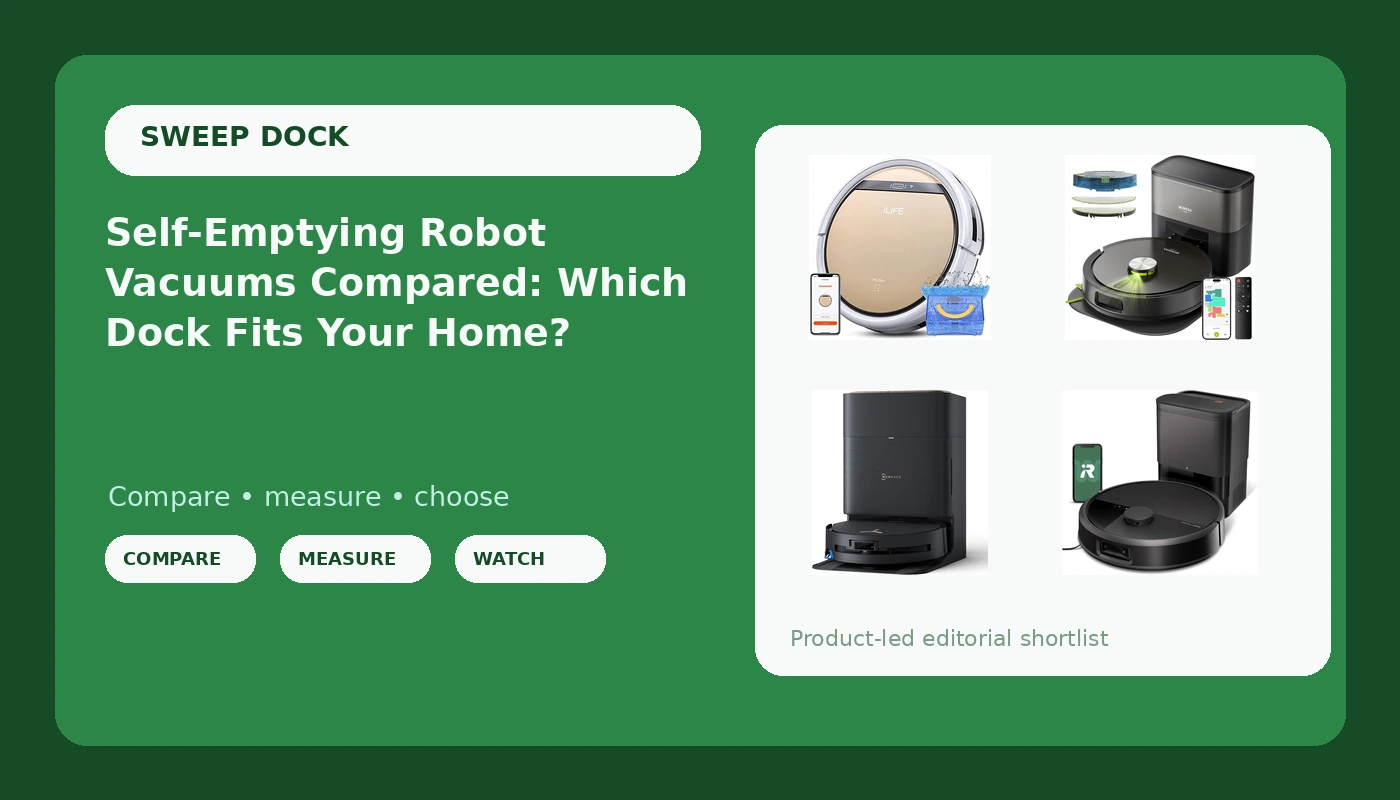
A self-emptying robot vacuum promises to take the worst part of robot ownership, the daily bin dump, off your plate. What it really does is move that chore to a dock. How often you deal with it depends on dock capacity, floor area, and how much hair your household sheds. The harder question is the one a spec sheet rarely answers: which of these machines will still be doing useful work in your house three months from now. That comes down to navigation, brush design, and what the mopping function can realistically handle. Below are four current models, from a plain vacuum and mop combo to a pet-focused flagship, with the published specs and the trade-offs those specs imply.
Related: LiDAR vs Random Navigation in Robot Vacuums →
Quick answer
If you want a self-emptying dock and mopping in one unit, the MONSGA Robot Vacuum and Mop sits in the middle of this group with 8,000Pa of rated suction and a 90-day self-emptying dock. If heavy pet shedding is the reason you are shopping, the iRobot Roomba Max 715 Pet is the one with dual rubber anti-tangle brushes, a side brush, and the highest rated suction figure here. If mopping is the main job, the ECOVACS DEEBOT X9 PRO Omni is the only model on this page built around a roller mop that washes itself. If you want the simplest way to vacuum and mop with one machine, the ILIFE V5s Plus is the least complicated option listed. None of these replaces a full-size vacuum.
Four useful options
| Model | Best fit | What stands out |
|---|---|---|
| MONSGA Robot Vacuum and Mop, 90 Days Self-Emptying with 8000Pa Suction | Homes that want self-emptying and mopping in one unit | 90-day self-emptying dock, 8,000Pa rated suction, vacuum and mop in one body |
| ECOVACS DEEBOT X9 PRO Omni Robot Vacuum, OZMO Roller Instant Self-Washing | Hard floors where mopping is the main job | OZMO Roller mop with instant self-washing |
| iRobot Roomba Max 715 Pet Robot Vacuum, 30,000Pa Suction, Dual Rubber Anti-Tangle Brushes & Side Brush, 90 Days Self-Emptying, PrecisionVision AI Obstacle Avoidance, 3D Mapping, Advanced Dirt Detect | Homes with heavy pet shedding | 30,000Pa rated suction, dual rubber anti-tangle brushes, side brush, 3D mapping, PrecisionVision AI obstacle avoidance, 90-day self-emptying dock |
| ILIFE V5s Plus Robot Vacuum and Mop Combo | Small spaces and light daily upkeep | Vacuum and mop in one unit without a dock |
The balanced self-emptying pick: MONSGA Robot Vacuum and Mop, 90 Days Self-Emptying with 8000Pa Suction
The appeal here is straightforward: one unit that vacuums, mops, and dumps its own bin into a dock for a stretch measured in months rather than days. The trade-off is that a 90-day claim is a capacity statement, not a promise about your house. A home with two heavy-shedding dogs fills a dock bag far faster than a home with one short-haired cat, because the figure depends on daily pickup volume. The listing also does not name a navigation technology, so if mapping and no-go zones matter to you, that is the question to ask before buying rather than after.
The mopping-first pick: ECOVACS DEEBOT X9 PRO Omni Robot Vacuum, OZMO Roller Instant Self-Washing
Instant self-washing targets the most annoying part of robot mopping: the moment you have to peel a dirty pad off the bottom and rinse it in the sink. A roller that washes itself during the run is a real change to that chore. It does not change what robot mopping is. A mopping robot handles dust, footprints, and light film on hard floors. Dried-on spills and sticky patches are still a job for a mop and a person. Treat the self-washing roller as a convenience upgrade on light maintenance, not as a floor scrubber, and the price of this model makes more sense.
The pet-hair pick: iRobot Roomba Max 715 Pet Robot Vacuum
This is the pet-hair specialist of the group, and it is the model where the spec sheet is most specific. The 30,000Pa suction figure is the highest here, but suction alone is not what lifts husky hair off low-pile carpet. The dual rubber anti-tangle brushes are the feature that matters, because rubber blades shed hair rather than winding it around a bristle roller, and the side brush is what reaches along baseboards and into corners. PrecisionVision AI obstacle avoidance and 3D mapping address the other half of the problem, which is coverage: a robot that maps and avoids obstacles finishes more of the floor per run. Advanced Dirt Detect is a cleaning-focus feature rather than a navigation one. The trade-off is complexity. Every one of those features is a system that can need attention, and they only pay off if your hair load actually justifies them.
The simple pick: ILIFE V5s Plus Robot Vacuum and Mop Combo
The V5s Plus is the least specified model on this page, and that is the point of it. It is a vacuum and mop combo without a self-emptying dock, which means you empty the bin yourself and you skip both the dock's footprint and its bag supply. For a small apartment or a single room, that can be the more sensible arrangement. For a whole main floor with shedding pets, it means daily contact with the bin. The other thing to verify on a simpler model is navigation, because without mapping a robot covers ground by bumping around, and that is the behavior that ends with a machine wedged under the sofa table.
Prices and availability may change. Product images, names, and retailer links are matched to verified product listings, so confirm the details on the listing before you buy.
What a 90-day self-emptying dock really means
Three of the four models here advertise a 90-day self-emptying dock. The claim describes how much debris the dock holds before the bag or container needs attention, based on assumptions about daily pickup volume. It is not a maintenance-free quarter. Filters still load up. Brushes still collect hair. The robot still has to return to the dock on its own, and a dock the robot cannot reach from the far bedroom is a dock that does nothing for you. If you want to know whether a 90-day figure is realistic for your home, look at how full your current vacuum canister gets in a week and scale from there. Two shedding dogs will compress that window hard.
Suction numbers, brushes, and what actually moves pet hair
Pascal ratings are the easiest spec to market and one of the hardest to compare. A figure like 8,000Pa or 30,000Pa is measured under conditions the manufacturer chooses, often at the inlet, and it says nothing about how well the machine seals against carpet or how long it holds that number as the filter loads. What moves pet hair is a combination of airflow, brush design, and how many passes the robot makes over the same patch. Rubber dual brushes resist tangling because hair slides off them instead of winding around a bristle roller. A side brush extends reach to edges. Mapping and obstacle avoidance determine whether the robot covers a room once, thoroughly, or covers the same corner three times and skips the hallway entirely.
- Decide whether you want a self-emptying dock at all, since it adds floor footprint and a recurring bag supply.
- Measure the floor area the robot will cover on one charge, and note rugs, thresholds, and cords.
- Match brush type to your hair load, favoring dual rubber anti-tangle brushes for heavy shedding.
- Decide what mopping has to do: light maintenance on hard floors, or nothing at all.
- Check whether the model publishes navigation and mapping details, because that determines how much you babysit it.
Practical guidance for any of these
- Pick up cords and thin rug edges before the first run, since tangles are the most common reason a robot stops mid-job.
- Run the robot while you are home for the first week so you learn its failure points instead of discovering them at 2 p.m. on a Tuesday.
- Keep the dock somewhere the robot can reach without navigating a maze of furniture.
- Empty and rinse the bin and clean filters and brushes on a schedule, whether or not the dock is self-emptying.
- Expect mopping to handle dust and footprints, and keep a real mop for anything dried on.
Which option should you choose?
Choose the MONSGA Robot Vacuum and Mop, 90 Days Self-Emptying with 8000Pa Suction when you want self-emptying and mopping in one unit and the middle of this group fits your plan. Choose the ECOVACS DEEBOT X9 PRO Omni Robot Vacuum, OZMO Roller Instant Self-Washing when hard floors are most of your house and you want the mopping chore reduced as far as a robot can reduce it. Choose the iRobot Roomba Max 715 Pet Robot Vacuum when shedding is the problem you are actually solving and the anti-tangle brushes, mapping, and obstacle avoidance are worth the added complexity. Choose the ILIFE V5s Plus Robot Vacuum and Mop Combo when you want one machine for light vacuuming and light mopping in a small space and you would rather not give a dock the corner.
One honest limit applies to all four. A robot vacuum is a maintenance tool. It keeps floors presentable between real cleanings and it is at its best on hard surfaces and low-pile carpet. If you have thick pile, heavy shedding, and a house full of obstacles, expect to supervise the robot no matter which model you buy.
The bottom line
The self-emptying dock is the feature that changes daily life the most, and three of these four models have one. Past that, the decision comes down to hair and hard floors. If you have shedding pets, prioritize anti-tangle brushes and mapping over a suction number. If you have hard floors, decide whether mopping is worth paying for, and be realistic that a robot mop handles film, not stains. If your space is small and simple, a basic vacuum and mop combo does the job without a dock in the corner. Whichever you pick, plan on emptying something, cleaning something, and occasionally pulling the robot out from under the couch.