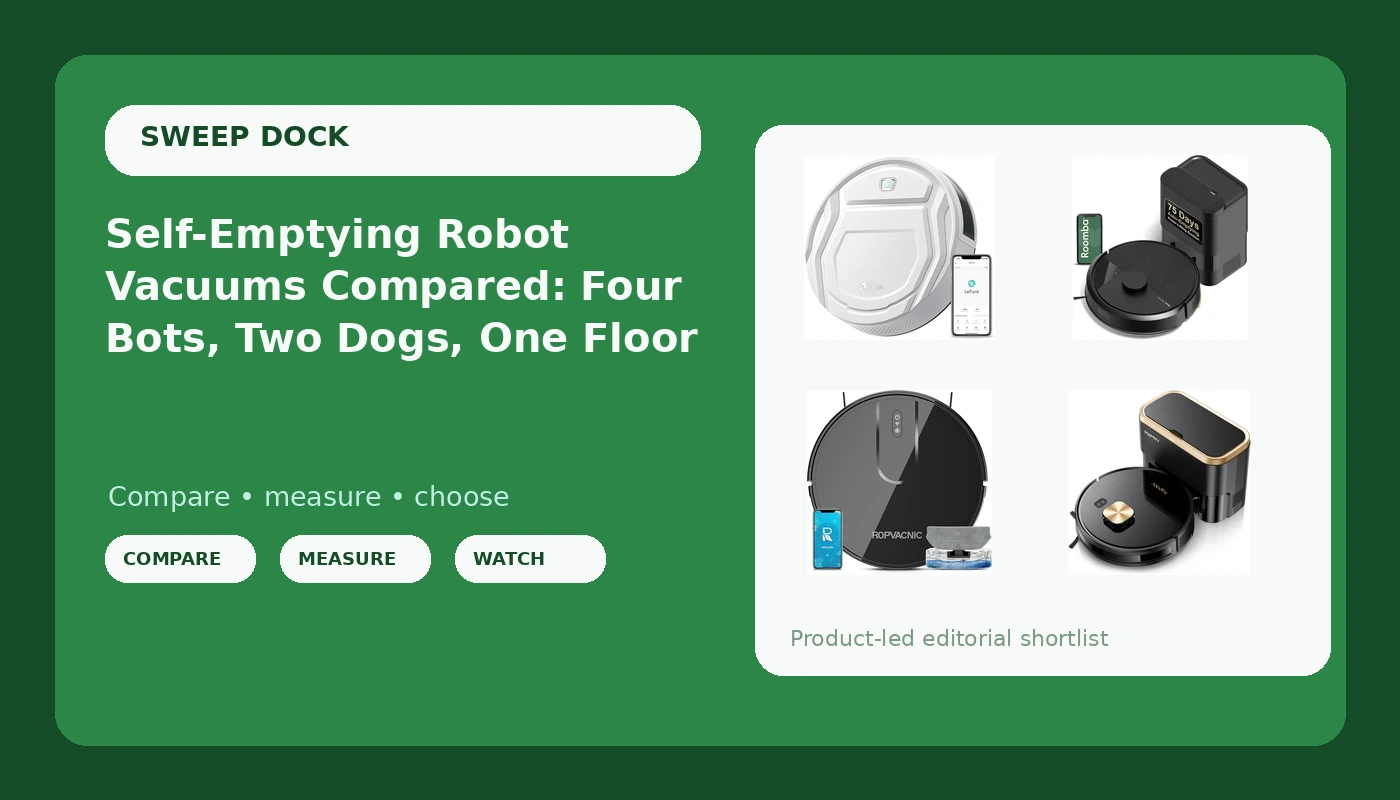
I have been running robot vacuums in a ranch-style house for about four years now, currently on my third unit, across hardwood in the living areas, tile in the kitchen, and low-pile carpet in the bedrooms. Two dogs live here, a husky and a lab, and together they shed roughly one extra dog per week. That is the context for this self-emptying robot vacuum comparison: four models, one floor plan, and one very specific question about how much of my evening I want to spend pulling a machine out from under the sofa table.
My first robot was a random-navigation bot that bounced off walls in a zig-zag pattern and wedged itself under that same sofa table every single run. I drove it around with my phone like an RC car just to finish a room. That experience is why I care more about navigation than I care about a suction number printed on a box.
The short answer: if you want the dock to handle the emptying, the 11500 Pa LiDAR model is the one I would put my own money on, because LiDAR plus a 90-day dock plus a 160-minute runtime is the combination that actually reduces babysitting. The Roomba 105 is the pick for the person who never wants to troubleshoot anything. The ROPVACNIC is the pet-hair value play. The Lefant M210 is the cheapest way to find out whether a robot vacuum fits your life at all.
Here is the table, then the reasoning behind every row.
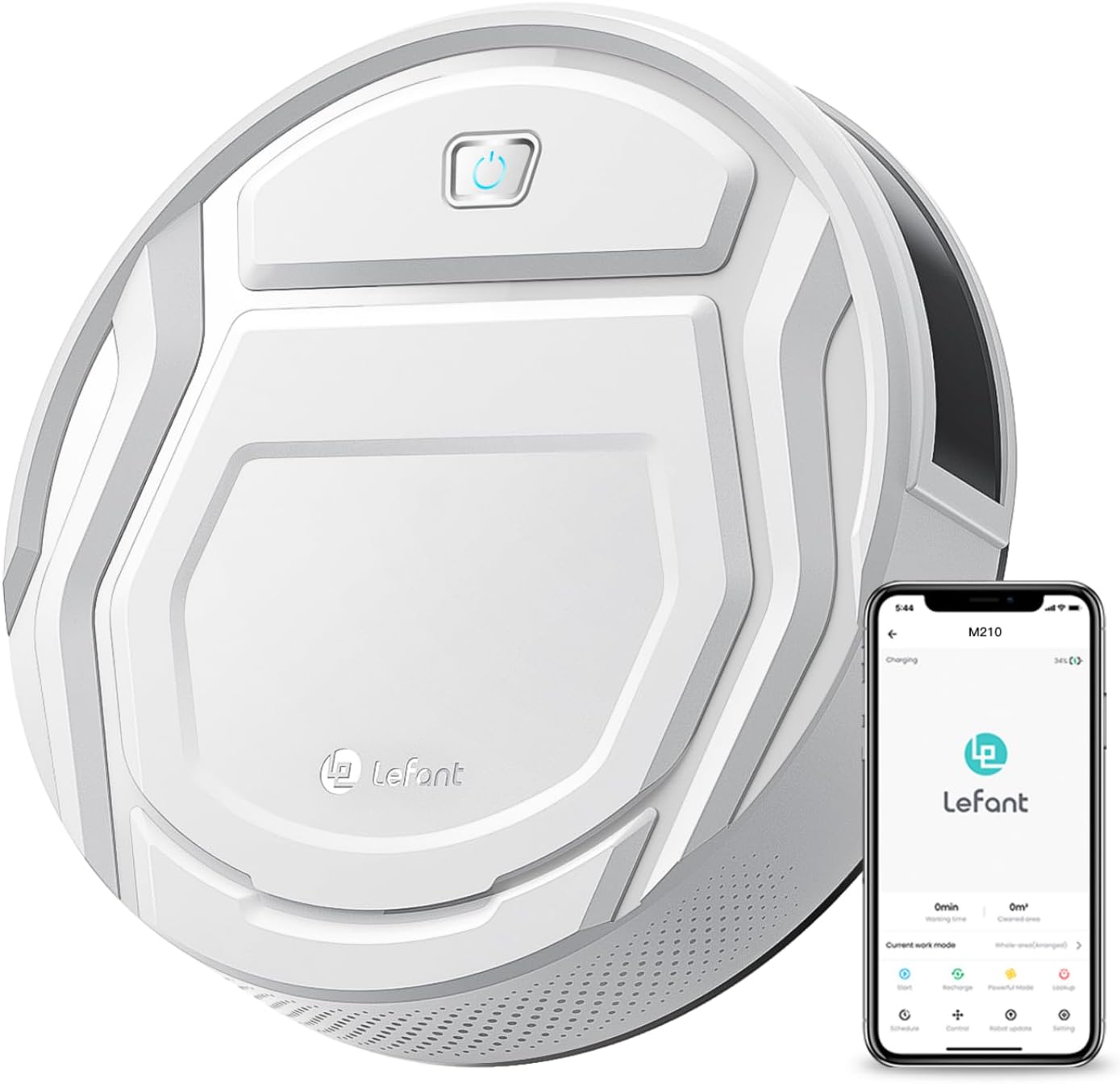
Lefant Robot Vacuum Cleaner M210
The cheapest way to find out whether you actually want a robot; 120-minute runtime, slim body, Wi-Fi and Alexa control, automatic self-charging, and pet hair pickup on hard floor
No LiDAR, so no map and no no-go zones; no self-empty dock; you will supervise it around cords and rug edges
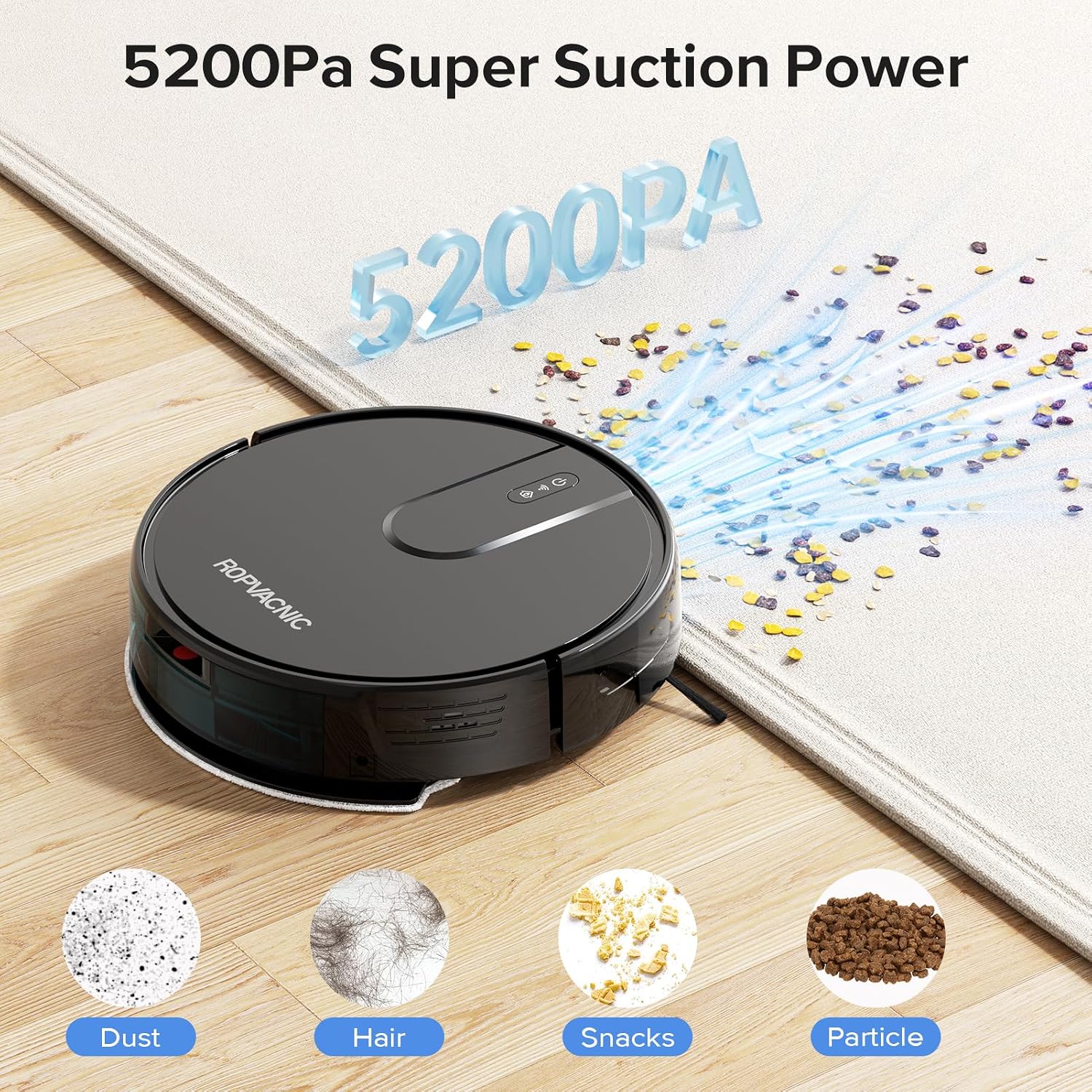
ROPVACNIC Robot Vacuum and Mop Combo 5200Pa
Best pet-hair value in this group; 5200Pa suction that lifts husky hair, a mop combo, and a quiet enough mode that I forget it is running
No LiDAR, so it bumps walls and gets caught in cords; no self-empty dock; you need to be home while it cleans
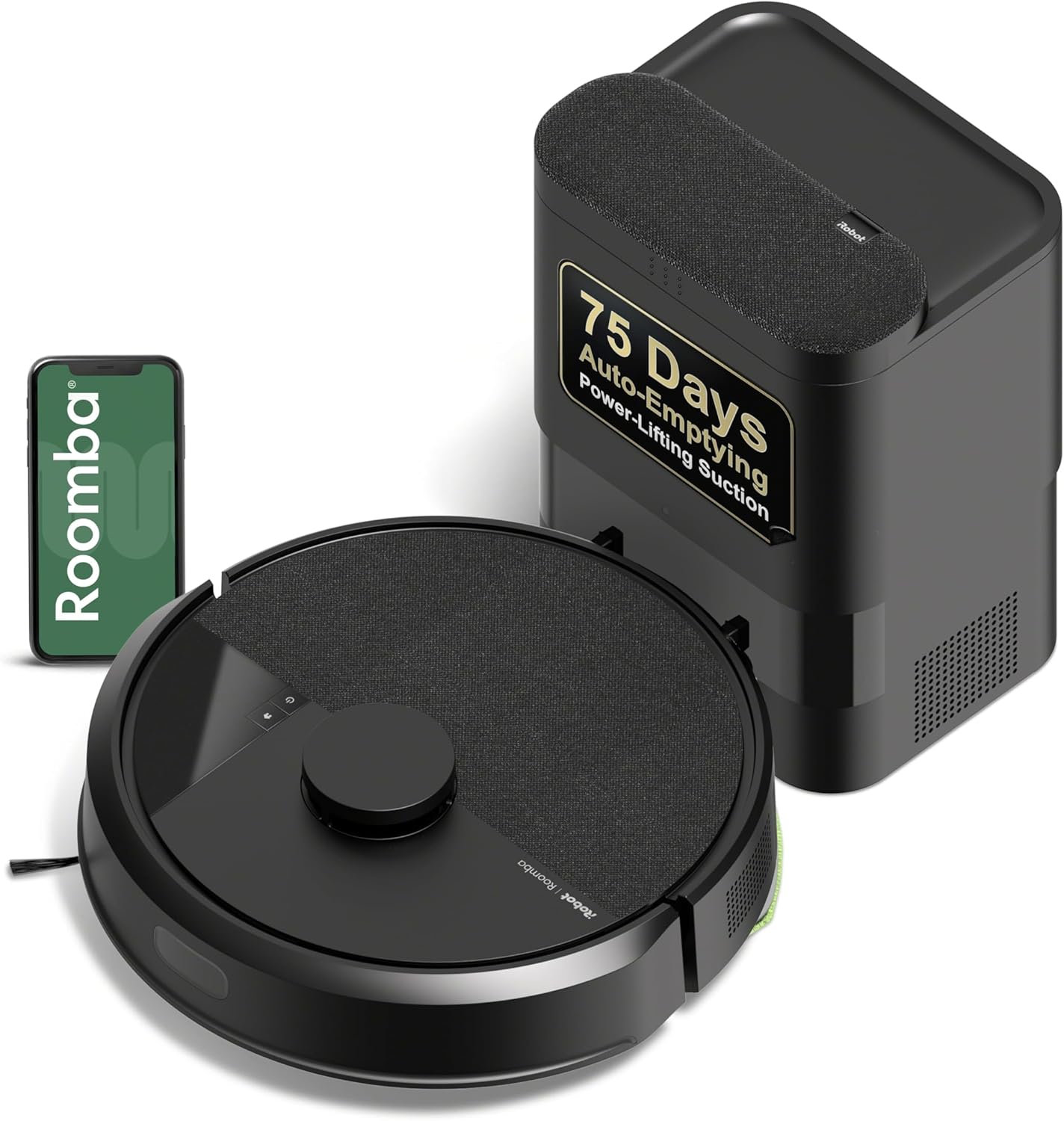
iRobot Roomba 105 Vac with AutoEmpty Dock
LiDAR navigation and neat-row cleaning, a dock that self-empties for 75 days, and the brand I recommend to people who never want to troubleshoot
No mopping at all, a shorter self-empty interval than the 90-day dock in this group, and you pay for the badge
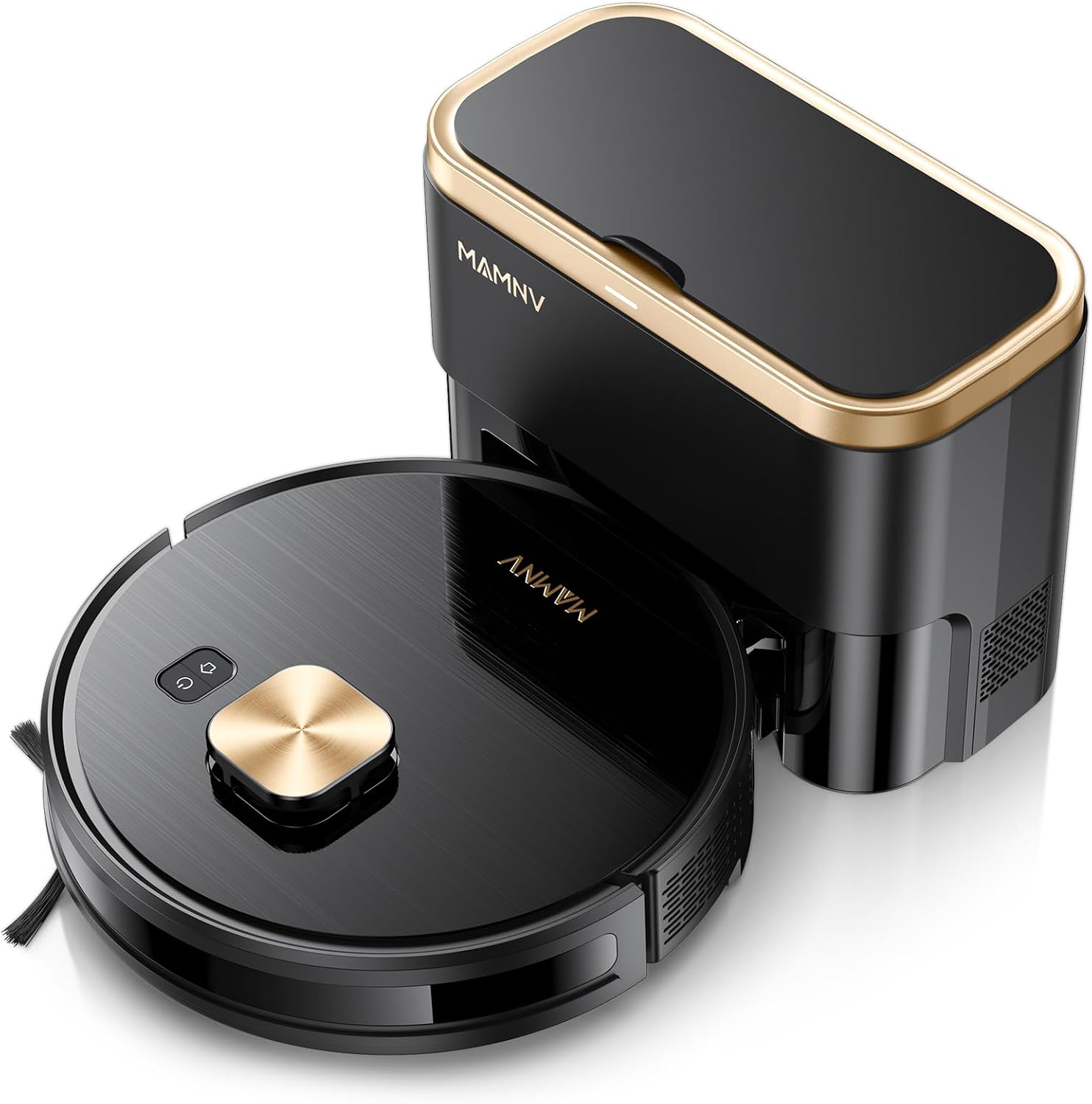
Robot Vacuum and Mop, 11500 Pa Suction, 3-in-1 with Smart LiDAR Navigation
The most complete spec sheet here: 11500 Pa suction, smart LiDAR navigation, 90-day self-emptying, 160-minute runtime, 3-in-1 vacuum and mop, app and Alexa and voice control
The newest name in the group with the least track record; the dock still needs bag and filter maintenance; a suction number on a box is not a floor test
Prices and availability were captured from Amazon Creators API and may change.
Navigation is the whole ballgame
Suction means nothing if the robot cannot find the dock or gets stuck on the same cord twice. That is not a slogan, it is the single lesson from four years and three machines.
LiDAR is the laser mapping that lets a robot know where it is. Without it you get random navigation: bumping walls, re-covering the same corner three times, skipping the hallway entirely. My first bot did exactly that, and the fix was not more power, it was a map.
Two models here have LiDAR on the spec sheet, the Roomba 105 and the 11500 Pa 3-in-1. That means room-by-room coverage, a map you can build no-go zones on, and a much better chance of the robot returning to its dock from the back bedroom instead of dying in a doorway. The Roomba 105 is described as cleaning in neat rows, which is the visible signature of LiDAR navigation: straight lines, even passes, no drunk zig-zag.
The ROPVACNIC and the Lefant M210 do not have LiDAR. That is not automatically a dealbreaker, it is a job description. Both are machines you run while you are home, with the floor picked up, because neither one is going to reason its way around a phone cord or a rug transition. If your place is a small apartment with hard floors and nowhere to get wedged, that trade is fine. In a house with two shedding dogs and a sofa table that eats bots, it is the difference between a tool and a hobby.
The self-emptying dock, and what it actually buys you
Self-emptying means the dock sucks the bin's contents into a bag so you do not empty it for weeks. It is a convenience, not a "never touch your robot again" solution. You still deal with filters, bags, and the occasional hair wrap on the brush.
The Roomba 105 AutoEmpty dock self-empties for 75 days. The 11500 Pa model lists a 90-day self-emptying cycle. Those are the two dock-equipped options in this comparison, and the difference between 75 and 90 days is roughly one extra bag change per year. That is not the deciding factor. The deciding factor is whether the robot finds the dock in the first place, because a dock that only gets used when you carry the robot to it is just a parking spot.
The Lefant M210 and the ROPVACNIC have no dock. You empty the bin yourself, which on two-dog hair means every other day. I will be honest about my own contradiction here: I preach self-emptying docks for convenience and I still empty my bin constantly because I like seeing the dog hair and knowing it is gone.
Pet hair is the only test that counts
My husky sheds a whole second dog every spring. If a robot cannot handle that, the app does not matter.
The ROPVACNIC is the one I have the most real-house time with. Its 5200Pa suction picks up husky hair without tangling, and its quiet mode is quiet enough that I forget it is running while the TV is at normal volume. It always finds the dock. It also has no LiDAR, bumps walls, and gets caught in cords, which is why it is a machine I run before I leave for an errand, not one I trust while I am at work.
The 11500 Pa 3-in-1 lists the highest suction in this group and is explicitly aimed at pet hair on carpet and hard floor. That is a promising number for a low-pile bedroom carpet, and it is also exactly the kind of claim I refuse to take at face value. Suction ratings come from a sealed test rig, not from the fuzz packed into a rug at the base of a couch. The honest read is that it has the hardware to compete and I would want a two-week run on my own carpet before calling it.
The Lefant M210 is marketed for pet hair on hard floor, and that is the right frame. Hard floor and a slim body are a good pairing for under-bed dust and kitchen crumbs. Low-pile carpet with a husky in the house is a heavier ask.
Mopping on a robot is light maintenance
Two models here mop: the ROPVACNIC and the 11500 Pa 3-in-1. The Roomba 105 does not mop. The Lefant M210 does not mop.
Robot mopping keeps everyday footprints off the floor. It does not touch dried-on stains or sticky spills, and anyone who calls it a deep clean has not watched one drag a damp pad across a dried coffee ring. I run the mop pass anyway, and then I hand-mop the kitchen afterward, because that is what light maintenance means. If mopping is your main reason for buying, buy a robot for vacuuming and keep a mop.
Runtime, and the dock-finding question
The Lefant M210 lists 120 minutes of runtime and automatic self-charging. The 11500 Pa model lists 160 minutes. The Roomba 105 and the ROPVACNIC do not publish a runtime in the materials I have, and I am not going to invent one for them.
Runtime matters less than people think, because most main floors do not need a single uninterrupted marathon. What matters more is whether the robot returns to the dock on its own when it is done or low, and whether it can find that dock from the farthest room rather than just from the hallway. A 160-minute battery that dies in the back bedroom is worth less than a 90-minute battery that parks itself every time. I do not trust a navigation claim until I have watched the robot make the trip from the back bedroom, not the easy run from the living room.
App, voice, and no-go zones
The Lefant M210 runs on Wi-Fi with app and Alexa control. The 11500 Pa model adds app, Alexa, and voice control to its LiDAR mapping. The Roomba 105 is positioned around being easy to use with LiDAR navigation. The ROPVACNIC has no LiDAR, so there is no map to draw no-go zones on, which means fencing off the dog bowls or the cable nest behind the TV stand is done with physical barriers, not a phone.
No-go zones are the feature that changes how much you babysit the machine. Fence off the three places it always gets stuck and a mediocre robot suddenly looks competent. That is also why I tell people to spend the extra on LiDAR before they spend it on suction: a map and no-go zones change everything about daily life with a robot, and a bigger suction number does not.
Who each one is for
Lefant Robot Vacuum Cleaner M210
This is the entry point. If you have hard floors, a small footprint, and no expectation of a map, it covers the basics with a slim body, a 120-minute runtime, app and Alexa control, and self-charging. Buy it to learn whether you will actually empty a bin and pick up cords before every run. Visit on Amazon →
ROPVACNIC Robot Vacuum and Mop Combo 5200Pa
The pet-hair value pick. It is the machine I have lived with, it lifts husky hair, it mops in a light-maintenance way, and it always finds the dock. The cost is supervision: no LiDAR, wall bumping, cord tangles, and no self-empty dock. Visit on Amazon →
iRobot Roomba 105 Vac with AutoEmpty Dock
This is the recommendation for someone who wants zero troubleshooting. LiDAR navigation, neat rows, multi-surface cleaning, and a dock that self-empties for 75 days. It does not mop, and you are paying for the name and the reliability rather than double the cleaning. Visit on Amazon →
Robot Vacuum and Mop, 11500 Pa, 3-in-1 with Smart LiDAR Navigation
The most complete package in this comparison: 11500 Pa suction, smart LiDAR navigation, a 90-day self-emptying dock, a 160-minute runtime, 3-in-1 vacuum and mop, and app, Alexa, and voice control. It is also the newest name here, so the trade is spec sheet versus track record. Visit on Amazon →
The trade-offs I would want you to sit with
First, a self-emptying dock is not a maintenance-free robot. Bags, filters, and brush hair still happen, and the 90-day figure is 90 days of dirt, not 90 days of never touching the machine.
Second, mopping is not deep cleaning on any of these. If you have dried-on stains, you own that job.
Third, under a certain budget you will babysit the robot. That is the honest trade-off, and it is why the two LiDAR models here are the ones I would point a busy household toward.
Fourth, no suction number survives a real floor unchanged. My husky is the test, not the box.
Bottom line
If you want the dock to empty itself and you want a map, the 11500 Pa LiDAR model is the one I would buy, with the understanding that you are trusting a newer name. If you want the least drama and you do not care about mopping, the Roomba 105 with its AutoEmpty dock is the safe pick. If pet hair is the whole point and you are willing to be home while it runs, the ROPVACNIC earns its place. And if you are still deciding whether you even want a robot vacuum, the Lefant M210 is the cheapest honest answer. It is not a replacement for your real vacuum. None of these are.