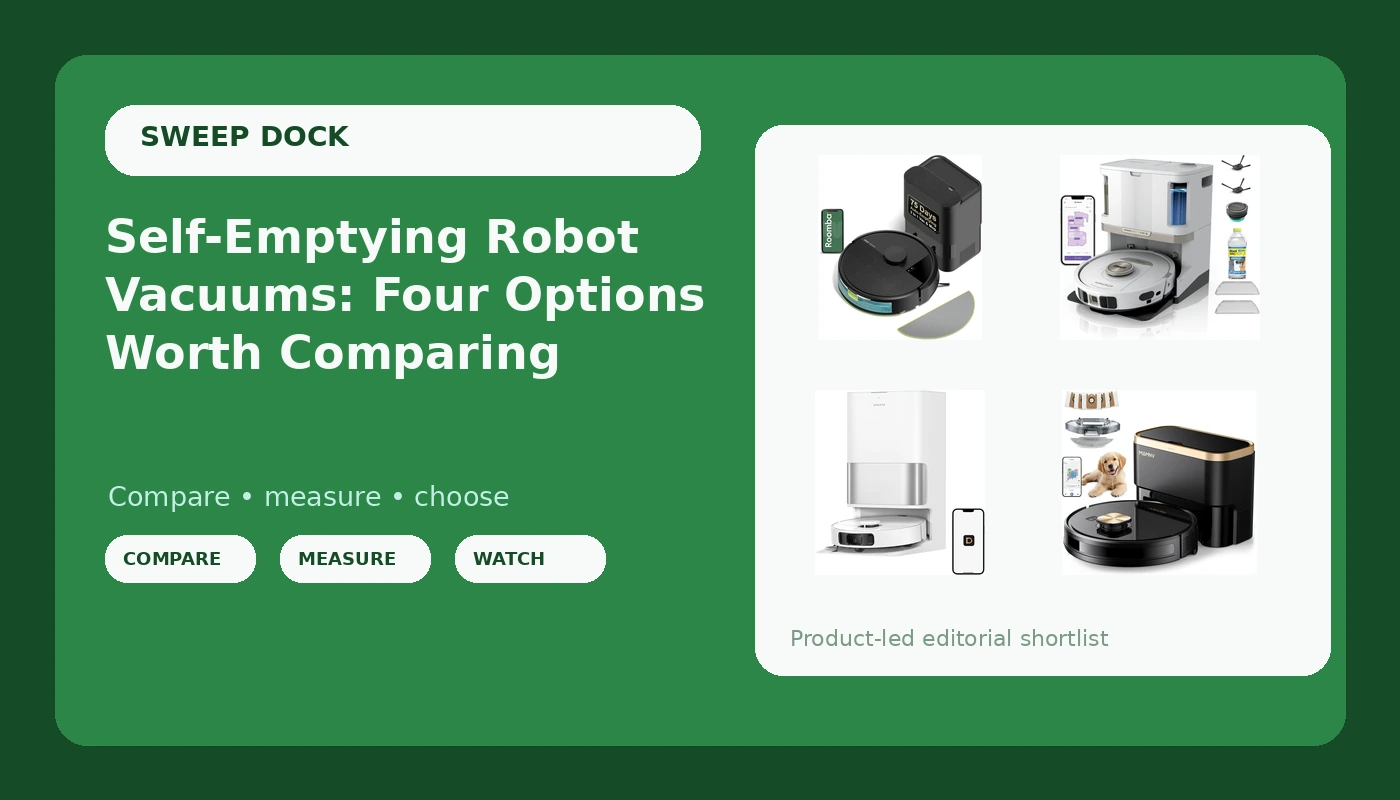
A self-emptying robot vacuum solves one specific problem: you stop handling the bin every day. That is the whole pitch, and it is worth being honest about what it does not cover. Four models sit in roughly the same buying conversation right now, and they arrive at the same feature set from different directions. One leans on a familiar brand name and a long dock interval, one pairs vacuuming and mopping with a shorter stated interval, one leads with a very large suction figure, and one is a LiDAR-equipped generic that undercuts the rest on price. None of them replaces your real vacuum. Each can keep a floor presentable between real vacuuming sessions, provided its navigation and dock behavior match the way you actually live.
Related: LiDAR vs Random Navigation: What Actually Changes →
Quick answer
Match the machine to your floors and your tolerance for babysitting, not to the largest number on the box. For a familiar brand and the longest stated self-empty interval in this group, start with the iRobot Roomba 105 Combo. For a vacuum-and-mop combo with a 60-day stated dock interval, look at the Shark PowerDetect. If suction specifications are what you weigh first, the dreame D30 Ultra CE lists the highest figure of the four. If you want LiDAR navigation and a self-empty dock at the lowest price in this comparison, the 11,500Pa model is the budget route.
Four useful options
| Model | Best fit | What stands out |
|---|---|---|
| iRobot Roomba 105 Combo Robot Vacuum & Mop with AutoEmpty Dock | Households that want a familiar brand and the longest stated dock interval here | LiDAR navigation; listing states the dock self-empties for 75 days |
| Shark PowerDetect Robot Vacuum & Mop Combo, AV2810ZEWH | Mixed-floor homes that want a vacuum-and-mop combo with a mid-length dock interval | Listing states a 60-day self-empty dock |
| dreame D30 Ultra CE Robot Vacuum and Mop | Buyers who weigh suction specifications first | Listing states 25,000Pa suction |
| Robot Vacuum, 11500Pa Suction, LiDAR Navigation, Self-Emptying, Pet Hair | Budget buyers who still want mapping and a self-empty dock | LiDAR navigation; listing states 11,500Pa suction; pet hair positioning |
The familiar name: iRobot Roomba 105 Combo
The 75-day figure is a dock capacity claim, not a promise that you will not touch the machine for two and a half months. Bags, filters, brushes, and the mop pad all still need attention on their own schedules, and the stated interval assumes a certain amount of debris per run. What the Roomba brings is the combination of LiDAR navigation, a self-empty dock, and carpet avoidance in mopping mode, which is the specific feature that keeps a wet pad off bedroom carpet. The trade-off is brand pricing. Part of what you pay goes toward the name and toward parts and support that are easy to find.
The mid-price combo: Shark PowerDetect Robot Vacuum & Mop Combo
The PowerDetect lands in the same band as the Roomba with a stated 60-day dock interval instead of 75. That difference is small in practice: both are measured in weeks, and both depend on how much hair and grit your floors produce. The interesting part of this listing is the combo design. If you want one machine that vacuums and mops and you are not chasing the longest interval on the page, this is the middle option. As with any self-emptying dock, plan on bag changes, filter cleaning, and mop pad washing on top of the stated interval.
The high-suction option: dreame D30 Ultra CE Robot Vacuum and Mop
25,000Pa is a large number, and suction matters most on carpet, where the brush has to pull debris out of fibers rather than sweep it off a hard surface. The catch is that suction only helps in the rooms the robot actually reaches. A high-suction machine with weak navigation cleans one corner very well and skips the hallway. This is also the highest-priced model of the four, so the question is whether the suction figure is the specification you care about most. If your main floor is mostly carpet and you already know the model maps your layout well, the number earns its keep. If your floor is mostly hardwood, it is mostly marketing.
The budget LiDAR route: Robot Vacuum, 11500Pa Suction, LiDAR Navigation, Self-Emptying, Pet Hair
This listing is the shortest and the least specific, and that is itself information. It promises LiDAR navigation, a stated 11,500Pa of suction, self-emptying, and pet hair handling, at the lowest price in this group. LiDAR plus a self-empty dock is the combination that used to cost a lot more, and getting both here is the reason to consider it. The trade-offs are the usual ones for a generically named model: support, app quality, and long-term parts availability are harder to predict than they are with an established brand. If you are comfortable with that, it is the value play. If you are not, the extra money buys certainty more than it buys cleaning.
Prices and availability may change. Product images, names, and retailer links are matched to verified listings. No current price, rating, stock status, or measured result is stated here without current evidence.
What a self-emptying dock actually covers
A self-emptying dock pulls the contents of the robot's bin into a bag inside the base. That is the entire mechanism, and everything the marketing implies beyond it is your job. You still replace the bag when it fills, clean or replace the filter, cut hair off the brush roll, wipe the sensors, and wash the mop pad after mopping runs. Docks also need floor space and clearance on both sides, and they need to sit somewhere the robot can reach reliably.
Stated intervals such as 60 or 75 days describe bag capacity under conditions the manufacturer chooses. In a house with two heavy-shedding dogs, that interval compresses. A better way to read the number is as a comparison between models rather than a schedule you can count on. If two machines state 60 and 75 days, the 75-day dock will generally go longer between bag changes in the same house, and neither will go as long as the box suggests when the floor is covered in fur.
There is also a maintenance floor you cannot get below. Even the best dock leaves you cleaning a filter, checking a brush, and dealing with the mop pad. Self-emptying removes the most frequent chore, not all of them.
Why navigation matters more than suction
Suction is the specification that sells, and navigation is the specification that decides whether the suction ever reaches your floor. A robot with LiDAR builds a map of your home, knows which room it is in, returns to its dock without wandering, and supports no-go zones you draw in the app. A robot without it moves until it bumps something, turns, and tries again. It will eventually cover a room, just not in a predictable order and not without your help.
All four models here claim LiDAR, which is worth noting. A few years ago that was the dividing line between budget and mid-tier machines; now it is close to table stakes in this price range. That shifts the comparison to the things LiDAR enables: room-specific cleaning, schedules that skip the bedroom while the dogs are shut in there, and no-go zones around the dog bowls, the cable nest behind the TV stand, and any rug the robot likes to eat.
Suction still matters, particularly on carpet. Higher suction figures generally correspond to better pickup of embedded debris from low-pile carpet, and pet hair is the hardest case because it both mats down and wraps around brush rolls. On hardwood and tile, airflow, brush design, and edge reach matter as much as the raw number. The practical rule: buy suction for your carpet, buy navigation for your whole house.
- Measure your cleanable floor area and note how much of it is carpet versus hard floor. That split determines how much the suction figure matters.
- Walk the floor and list the obstacles: charging cables, rug edges, dog bowls, table legs, and anything the robot could wedge under.
- Decide whether you want mopping at all, and if so, which rooms. A combo machine only helps if the mop mode can avoid your carpet.
- Read the stated dock interval as a relative comparison, then decide whether bag changes and filter cleaning fit your routine.
- Confirm the app supports scheduling and no-go zones before buying, because those two features decide how much you babysit the robot.
Practical guidance for a shedding household
- Run the robot while you are home for the first two weeks. You learn where it gets stuck faster than any review can tell you.
- Pick up charging cables and thin cords before every run, or fence them off with a no-go zone. Cords are the most common reason a robot stops working mid-clean.
- Keep the dock clear on both sides and in front. A dock tucked into a corner with no approach room causes failed returns.
- Check the brush roll weekly during shedding season. Hair wraps are a frequent cause of reduced pickup.
- Treat mopping as light maintenance. It handles dust and footprints; it does not remove dried-on spills, and expecting that is how people decide robot mopping is useless.
- Empty the dock bag when it fills rather than when the app complains, and rinse or replace the filter on schedule.
Which option should you choose?
Choose the iRobot Roomba 105 Combo when you want the most recognizable name here, LiDAR mapping, and the longest stated self-empty interval of the group, along with a mop mode that stays off carpet. Choose the Shark PowerDetect Robot Vacuum & Mop Combo when you want a vacuum-and-mop combo with a stated 60-day dock and you are comfortable with a slightly shorter interval. Choose the dreame D30 Ultra CE when carpet pickup is your priority and the 25,000Pa figure is the specification you trust most. Choose the Robot Vacuum with 11,500Pa suction, LiDAR navigation, and self-emptying when you want mapping and a self-empty dock at the lowest price in this comparison and you accept the uncertainty that comes with a generically named model.
One caveat applies to all four: this comparison uses the specifications each listing states, not a side-by-side floor test. Suction figures, dock intervals, and navigation claims are manufacturer statements, and they are worth confirming on the current listing before you buy, along with the app features for the exact model and region.
The bottom line
A self-emptying robot vacuum is a maintenance tool, not a replacement for a real vacuum, and the dock is a convenience rather than a cure. The Roomba 105 Combo is the safe, familiar pick with the longest stated interval here. The Shark PowerDetect is the mid-priced combo. The dreame D30 Ultra CE is for buyers who put suction first. The generically named LiDAR model is the budget route to mapping and self-emptying. Whichever you pick, judge it on whether it finds its dock, whether it gets stuck on the same cord twice, and whether the bin survives a week of dog hair. Those three answers matter more than any number on the box.